Look inside
Family STEM Challenges: 30 Hands-On Science and Engineering Projects for Kids
30 printable STEM challenges for ages 5 to 11, using household materials, with a recording sheet and the science explained for every one
Price
$12.99Was $19.99
Buying opens soon. Nothing on Bookstorez is on sale yet.
Look inside
What you get
| File | Format | Size |
|---|---|---|
| family-stem-challenges-screen-letter.pdf | 1.4 MB | |
| family-stem-challenges-screen-a4.pdf | 1.4 MB | |
| family-stem-challenges-planner-fillable-letter.pdf | 122.8 KB | |
| family-stem-challenges-planner-fillable-a4.pdf | 123.3 KB | |
| family-stem-challenges-print-edition.zip | ZIP | 3.1 MB |
| Pages | 76 pages | |
About this product
This is a printable book of 30 hands-on science and engineering challenges, designed for families with children aged 5 to 11. Each challenge uses things you already have at home, takes about 30 to 45 minutes, and comes with a recording sheet for the child and a plain explanation of the science for you. 76 pages, in US Letter and A4.
A challenge is a problem to solve by building and testing, not a recipe to follow. "Build a bridge from one sheet of paper that holds as many coins as you can." Your child plans, builds, tests, and then improves the design. You do not need a science background: the explanation is written out for you, with the real science word named.
How you use it
- Pick a challenge from the chart. It shows the age fit, the time and how messy it gets.
- Gather the items under "You need". Most are in the kitchen or the recycling box, and swaps are given.
- Print two pages: the challenge page for you and the recording sheet for the child.
- Run the session: plan, build, test, improve. A page at the front shows how the 30 to 45 minutes go.
- Read "Why it works" together.
Page 6 shows a recording sheet filled in by a child, so you can see what a finished one looks like before you start.
Every challenge is two pages
- Left page, for you: the challenge in one sentence, a drawn picture of one way to set it up, what you need with swaps, the time, the steps, a safety note, a question to ask before you start, and an easier and a harder version for younger and older children.
- Right page, for the child: a box to draw the plan, a prediction, a results table made for that challenge, "What happened?", "Next time I would change", and a short "Why it works" in plain words. The type is large and the writing lines are wide.
The 30 challenges
- Build and balance: Paper Bridge, Paper Book Stand, Newspaper Tower, The Leaning Stack, Find the Balance Point, Balanced Mobile.
- Forces and motion: Balloon Rocket, Balloon-Powered Car, Paper Plane Test Flight, Craft-Stick Catapult, Ramp Race, Paper Helicopter.
- Water and air: Foil Boat, Bottle Diver, Walking Water, Drops on a Coin, Toy Parachute, The Dry Dive.
- Light, sound and heat: String Telephone, Rubber Band Guitar, Shadow Size Lab, Flip the Arrow, Ice Cube Keeper, Pizza Box Solar Oven.
- Living things and the kitchen: Bean in a Bag, Color-Change Flower, Yeast Balloon, Fizz Balloon, Oobleck, Heartbeat Count.
Where the science comes from
Every method and every "Why it works" was taken from a published page from Scientific American's Bring Science Home series (written with Science Buddies), the Exploratorium, NASA's Jet Propulsion Laboratory, PBS Building Big, TeachEngineering at the University of Colorado Boulder, Science World, the Institute of Physics or Nemours KidsHealth, with the paper plane folds from the Smithsonian National Air and Space Museum and the balloon safety rule from the US Consumer Product Safety Commission. 42 pages were read in October 2026 and they are listed at the back, challenge by challenge. Anything that could not be found on one of them was left out. The wording is our own, written for families. The book is independent and is not connected with or approved by any of those bodies.
Also inside
- For the grown-up (8 pages): what this is and how to use it, how a session runs, the design loop (ask, plan, build, test, improve) as a diagram, how to help without doing it for them, questions to ask, what to do when a test fails, how to read a challenge page, and safety rules for every challenge.
- A chart of all 30 with age fit, time, mess level, adult steps and page numbers.
- A master materials list with tick boxes, sorted by where things are kept, showing which challenges use each item.
- Paper helicopter templates to cut out, and a blank recording sheet for a second try or a challenge of your own.
- 37 science words in plain language, a STEM log and two certificates.
What it does not do
- It is not a full science curriculum and it does not claim to match any set of school standards.
- It makes no promise about results.
- It does not replace an adult. A grown-up should be present for every challenge, and 11 of the 30 have a step, such as cutting or making a hole, that only an adult should do. Those pages are marked.
- No stoves or flames, and no chemicals beyond vinegar, baking soda, dish soap and food coloring. The solar oven uses sunshine.
What you download
- The book for reading on screen, in US Letter and A4, with linked contents.
- A fillable planner in both sizes: the chart, the materials list and the STEM log, to type into on a computer.
- One ZIP with the low-ink edition for printing in both sizes (white pages, black and white, light on ink) and a Start here page.
- You need only one paper size: Letter for the USA and Canada, A4 for almost everywhere else.
Good to know
- You may print any page as often as you like for your own family or your own class. Please do not share or resell the files.
- Spelling is American (color, center). Measurements are given in inches and in centimeters.
- A few things may need buying: balloons, craft sticks, dry yeast, food coloring, cornstarch and a white flower. Very little food is used.
- Some challenges are watched over hours or days (the bean, the flower, walking water). The chart says which.
- The fillable planner is made for a desktop PDF reader such as the free Adobe Acrobat Reader. Many phone and tablet apps do not keep typed entries.
- Print at 100% or "actual size", not "fit to page".
- The pictures are simple line drawings made for this book. The text was written with the help of AI tools and checked against the published sources.
- This is a digital download. Nothing is posted to you, and you need a printer or a print shop.
Contents
- Cover
- Start here
- Start here
- For the grown-up
- How a challenge session runs
- How to help without doing it for them
- How to read a challenge, and the safety rules
- A recording sheet filled in
- All 30 challenges at a glance
- Master materials list
- Master materials list, continued
- Build and balance
- 1. Paper Bridge
- 2. Paper Book Stand
- 3. Newspaper Tower
- 4. The Leaning Stack
- 5. Find the Balance Point
- 6. Balanced Mobile
- Forces and motion
- 7. Balloon Rocket
- 8. Balloon-Powered Car
- 9. Paper Plane Test Flight
- 10. Craft-Stick Catapult
- 11. Ramp Race
- 12. Paper Helicopter
- Water and air
- 13. Foil Boat
- 14. Bottle Diver
- 15. Walking Water
- 16. Drops on a Coin
- 17. Toy Parachute
- 18. The Dry Dive
- Light, sound and heat
- 19. String Telephone
- 20. Rubber Band Guitar
- 21. Shadow Size Lab
- 22. Flip the Arrow
- 23. Ice Cube Keeper
- 24. Pizza Box Solar Oven
- Living things and the kitchen
Category: Workbooks
Topics: Science education · Engineering projects · Homeschool planning
AI-assisted
More from Handy Home Schooling
 Item 1493
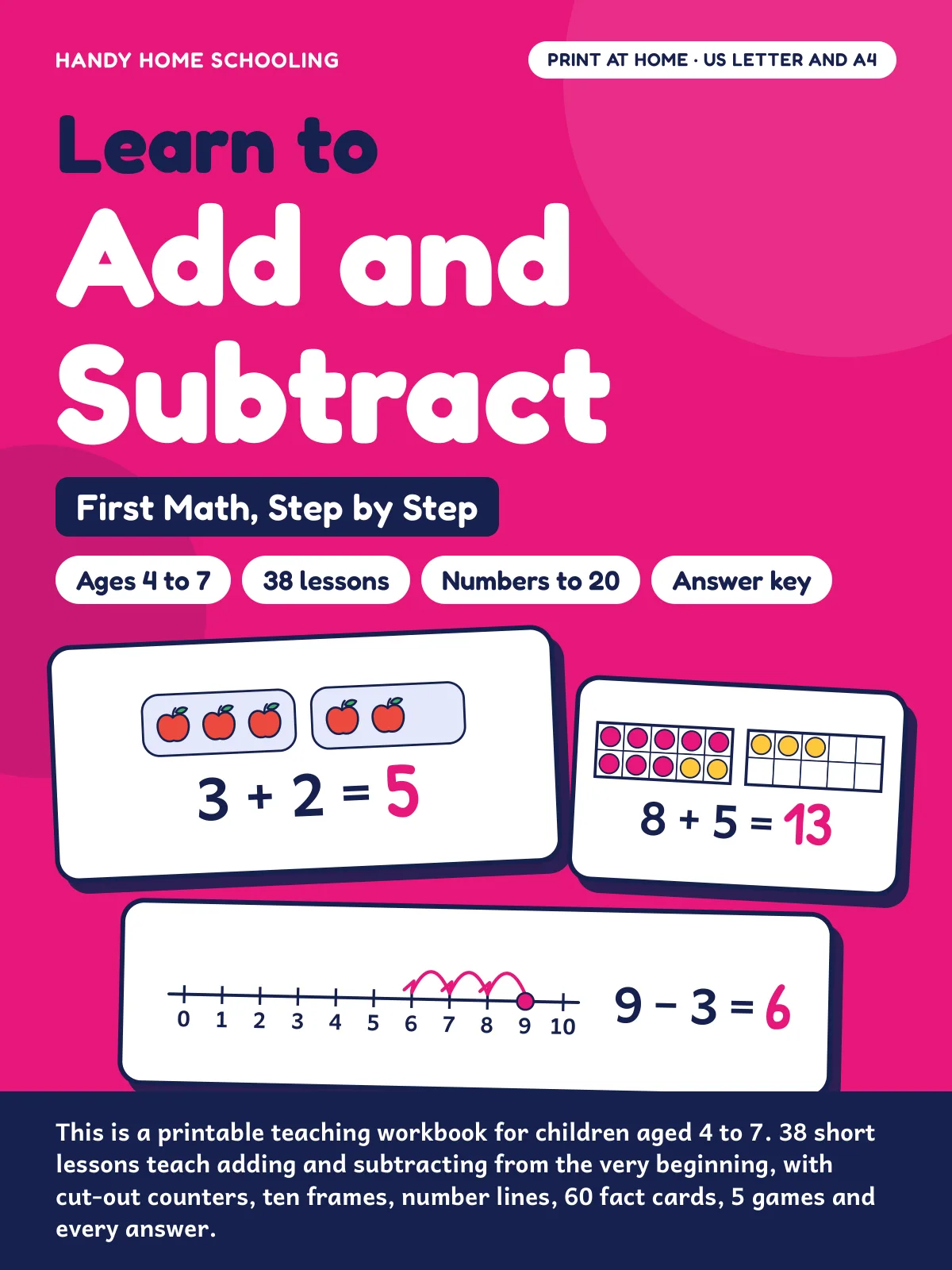
Learn to Add and Subtract: First Math, Step by Step
Handy Home Schooling
$12.99Was $19.99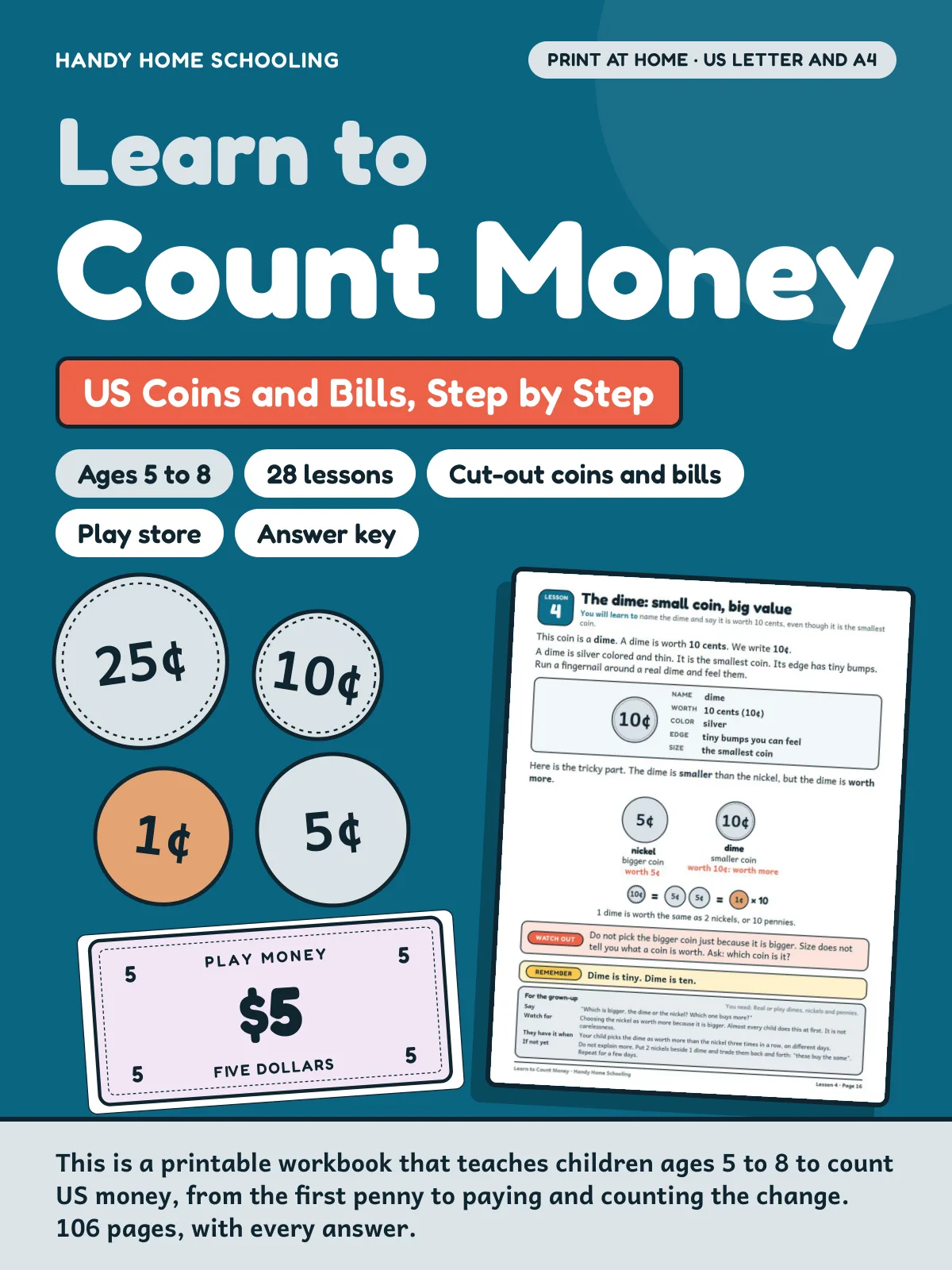 Item 1494
Learn to Count Money: US Coins and Bills, Step by Step
Handy Home Schooling
$12.99Was $19.99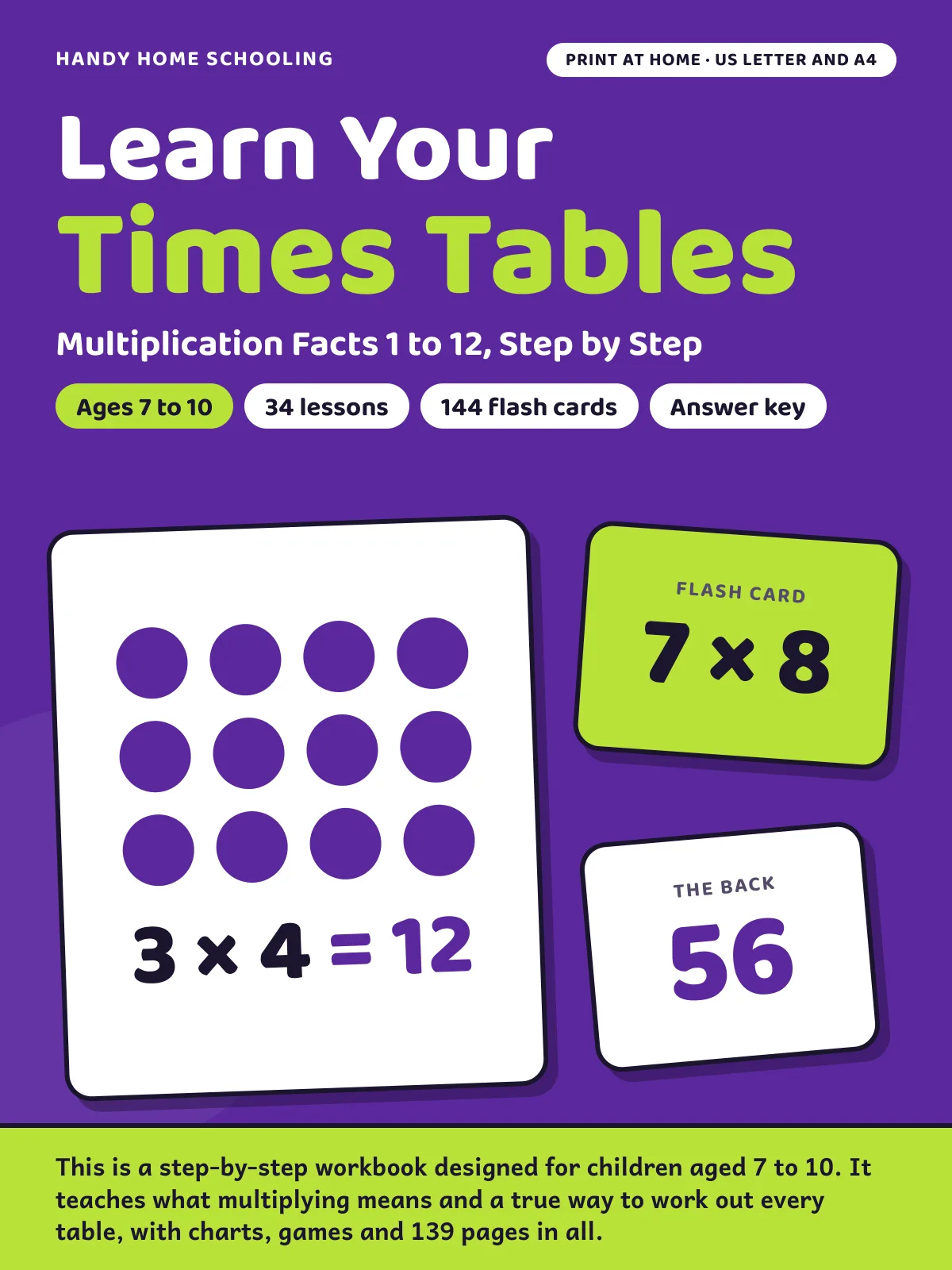 Item 1495
Learn Your Times Tables: Multiplication Facts 1 to 12, Step by Step
Handy Home Schooling
$12.99Was $19.99 Item 1496
Learn to Spell: 36 Weeks of Spelling Lessons, Step by Step
Handy Home Schooling
$12.99Was $19.99