
Look inside
How to Start Homeschooling: A Beginner's Guide with Printable Schedules and Checklists (2026 Edition)
A step-by-step guide for parents in their first year of homeschooling in the United States, with 15 printable record sheets, each shown filled in
Price
$12.99Was $19.99
Buying opens soon. Nothing on Bookstorez is on sale yet.
Look inside
What you get
| File | Format | Size |
|---|---|---|
| homeschool-beginners-guide-screen-letter.pdf | 2.0 MB | |
| homeschool-beginners-guide-screen-a4.pdf | 1.9 MB | |
| homeschool-beginners-guide-printables-fillable-letter.pdf | 349.2 KB | |
| homeschool-beginners-guide-printables-fillable-a4.pdf | 351.0 KB | |
| homeschool-beginners-guide-print-edition.zip | ZIP | 3.5 MB |
| Pages | 71 pages | |
About this product
This is a step-by-step guide designed for parents in their first year of homeschooling in the United States. 2026 edition: 71 pages, the first 30 days as a numbered path, 8 approaches compared, 3 drawn sample days and 15 printable record sheets, each shown filled in.
Most parents who decide to homeschool get stuck in the same places. What does my state want from me? What do we actually do all day? What do I buy? How do I teach a 5-year-old and a 12-year-old at once? What do I have to keep? This guide takes those questions in the order you meet them, and gives you the sheets to go with each one.
Checked against official sources in October 2026. Every figure, date and quotation was matched to a saved page: 78 in all, including the official homeschool page of all 50 states and the District of Columbia. They are listed in the guide.
How you use it
- Read the 30-day path (one page), then the two pages that take each of its twelve steps in turn.
- Do the legal step: read your state's own page with the one-page method, and copy what it asks onto the legal-step checklist.
- Keep the first weeks light while you read about approaches and what a real day looks like.
- Compare two or three options for math and reading on the comparison sheet. Buy those two only.
- Set up your records: a check mark a day, ten minutes on Friday, a review each quarter.
Part one: the guide (36 pages)
- The first 30 days as a drawn path of twelve steps, with how long each takes, what to use and what to say.
- The legal step, in general terms: the six kinds of requirement that exist (notice, subjects, days or hours, assessment, parent qualification, records), each shown in a state education department's own words as an example, plus a one-page method for reading your own state's page.
- All 51 official state pages: the agency and the web address of its homeschool page, each opened and checked in October 2026, linked in the PDF.
- Eight approaches compared in one table with what a day looks like in each: traditional, classical, Charlotte Mason, unit studies, Montessori-inspired, unschooling, eclectic and online. Then a half page on each, with one thing to try for a week.
- Curriculum: the types, ten checks before you buy, and what to buy in which week so you do not overspend.
- Your days: three sample days drawn hour by hour (one child; three children aged 5, 8 and 12; a parent who works afternoons), loop schedules, teaching several ages together, and deschooling.
- Records: what to keep and why, and a portfolio built in ten minutes a week.
- The first year: friends and groups, where the money goes, ten common mistakes, and a table for when it is not working.
Part two: 15 printables, each filled in for one example family and then blank
First-30-days checklist, legal-step checklist, curriculum comparison sheet, weekly schedule, daily routine chart, a child's picture routine with 16 picture squares to cut out, loop schedule, attendance record (180 days), portfolio and work-sample log, reading log, field-trip log, supply list, budget sheet, year at a glance and quarterly review.
What it does not do
- It is not legal advice, and it does not tell you what your state requires. It has no state-by-state table of rules: rules change, and your state's own page is the authority. It shows you how to read that page and gives you its address.
- It names, recommends and rates no curriculum, and quotes no prices or cost ranges.
- It is secular: no religious content, and nothing against it.
- It promises no results.
- It is a beginner's guide. High school transcripts and credits are outside it.
What you download
- The guide in US Letter and A4, for reading on screen, with linked contents and linked state addresses.
- The 15 blank printables as a fillable file in both sizes, for typing into on a computer.
- One ZIP with the low-ink print edition in both sizes (white pages, clear in black and white) and a one-page Start Here sheet.
Good to know
- Written for the United States, in US English. Readers in the UK, Canada and Australia can use everything except the legal pages; one page says where to start there.
- You need one paper size: Letter for the USA and Canada, A4 for almost everywhere else. Both are in the download.
- The fillable file is made for a desktop PDF reader such as the free Adobe Acrobat Reader. Many phone and tablet apps do not keep typed entries.
- Print at 100% or "actual size", not "fit to page". Print any page as often as you like for your own family.
- The example family, their state and the amounts on the example budget sheet are invented.
Contents
- Cover
- Start here
- Start here
- Map of this guide, and contents
- Decide and begin
- The first 30 days, step by step
- What homeschooling is
- A real day, drawn: three children
- Is it right for us? Seven honest questions
- Days 1 to 14 in detail
- Days 15 to 30 in detail
- The legal step
- Who makes the rules
- The six kinds of requirement: 1 to 3
- The six kinds of requirement: 4 to 6
- Find your state's rules: a one-page method
- Official state pages: Alabama to Missouri
- Official state pages: Montana to Wyoming
- Leaving a school, online schools, moving, other countries
- Approaches
- Eight approaches compared
- Traditional, and classical
- Charlotte Mason, and unit studies
- Montessori-inspired, and unschooling
- Eclectic, online, and how to choose
- Curriculum
- The types of curriculum
- How to judge a curriculum: ten checks
- Buying without overspending
- Your days
- What a realistic day is
- Sample day: one child
- Sample day: a working parent
- A weekly rhythm, and loop schedules
- Teaching several ages together
- Several ages: who gets you, and when
- Deschooling: the first weeks out of school
- Records
- What to keep, and why
- A portfolio in ten minutes a week
More from Handy Home Schooling
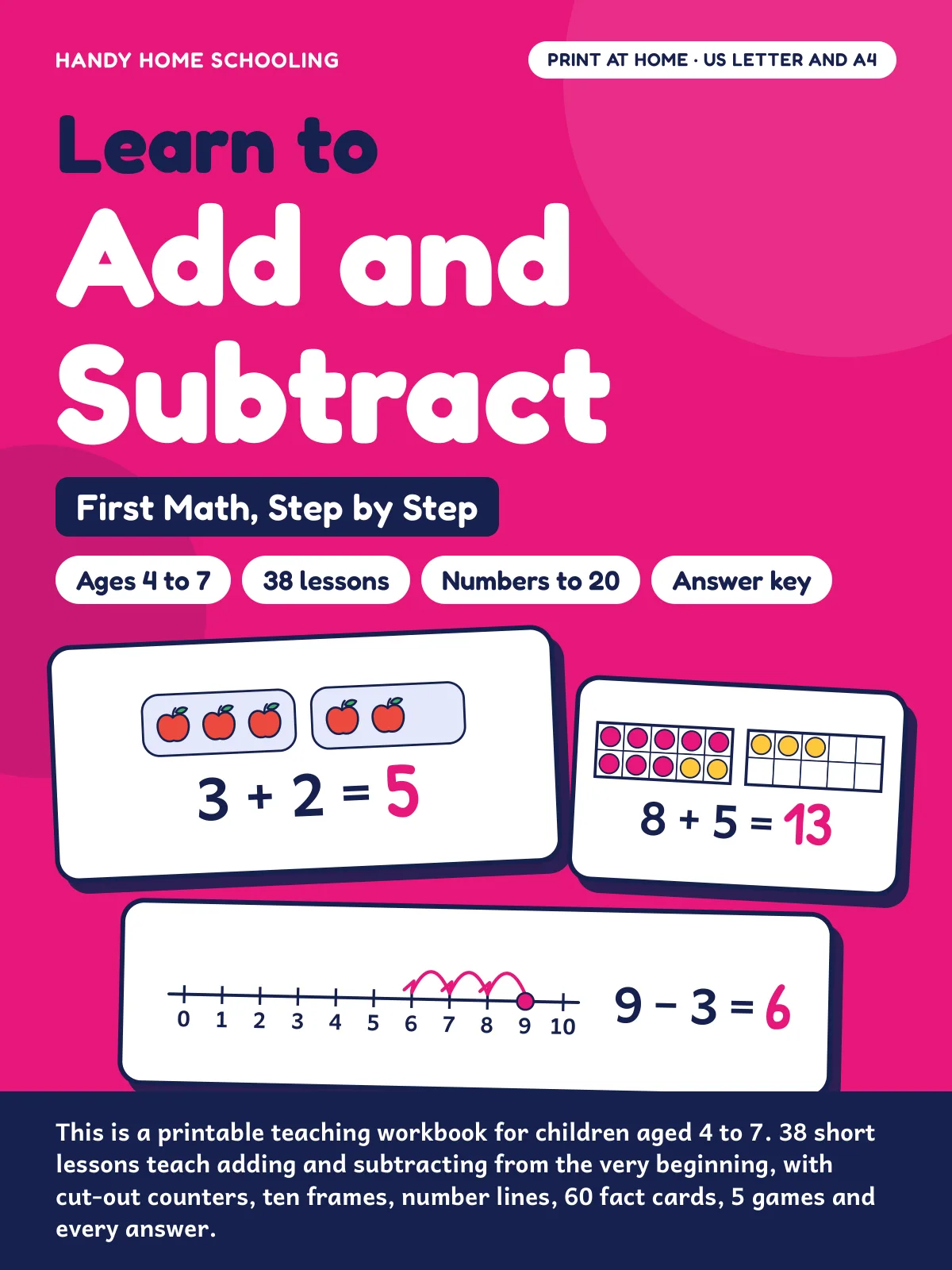 Item 1493
Learn to Add and Subtract: First Math, Step by Step
Handy Home Schooling
$12.99Was $19.99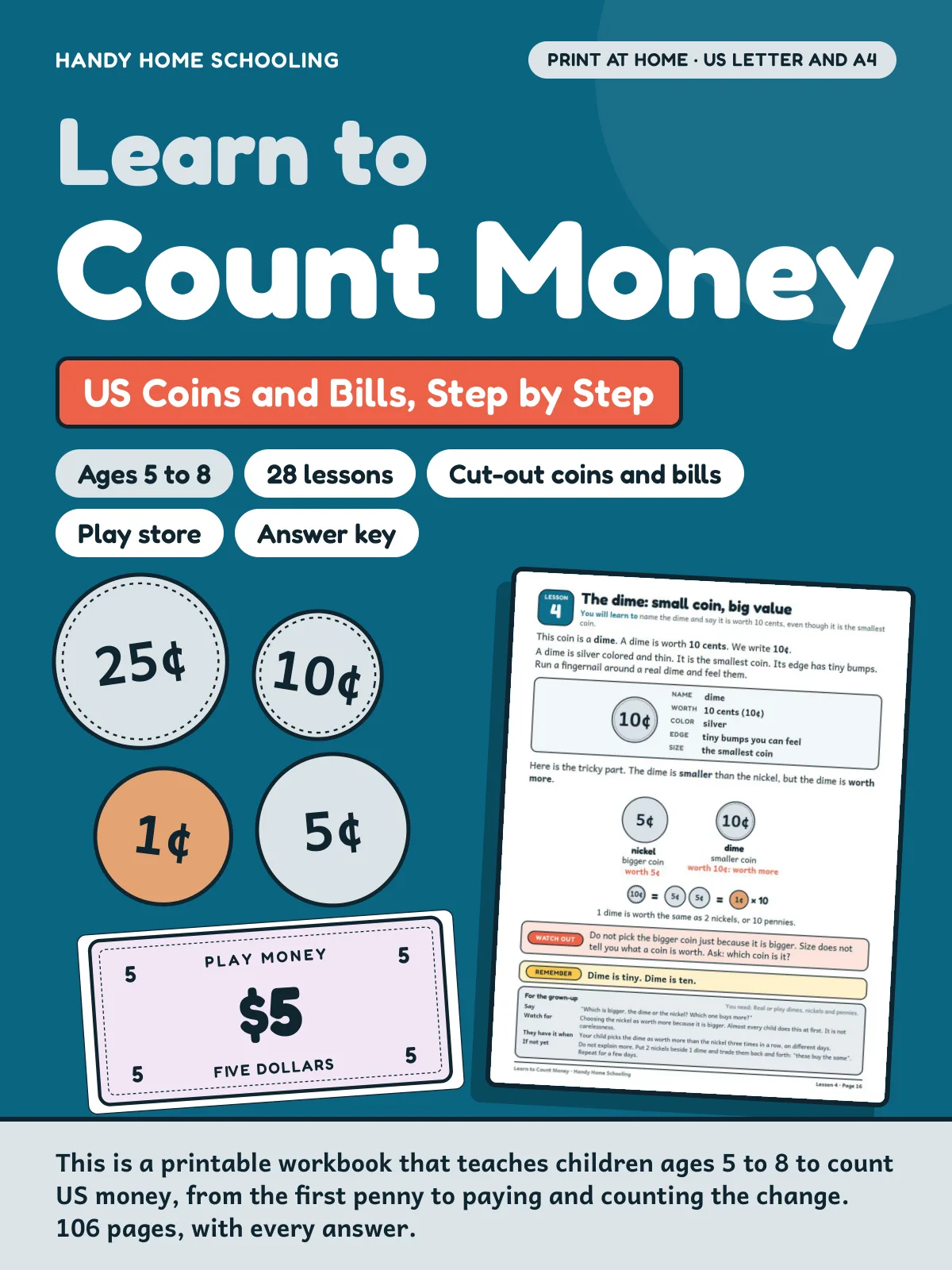 Item 1494
Learn to Count Money: US Coins and Bills, Step by Step
Handy Home Schooling
$12.99Was $19.99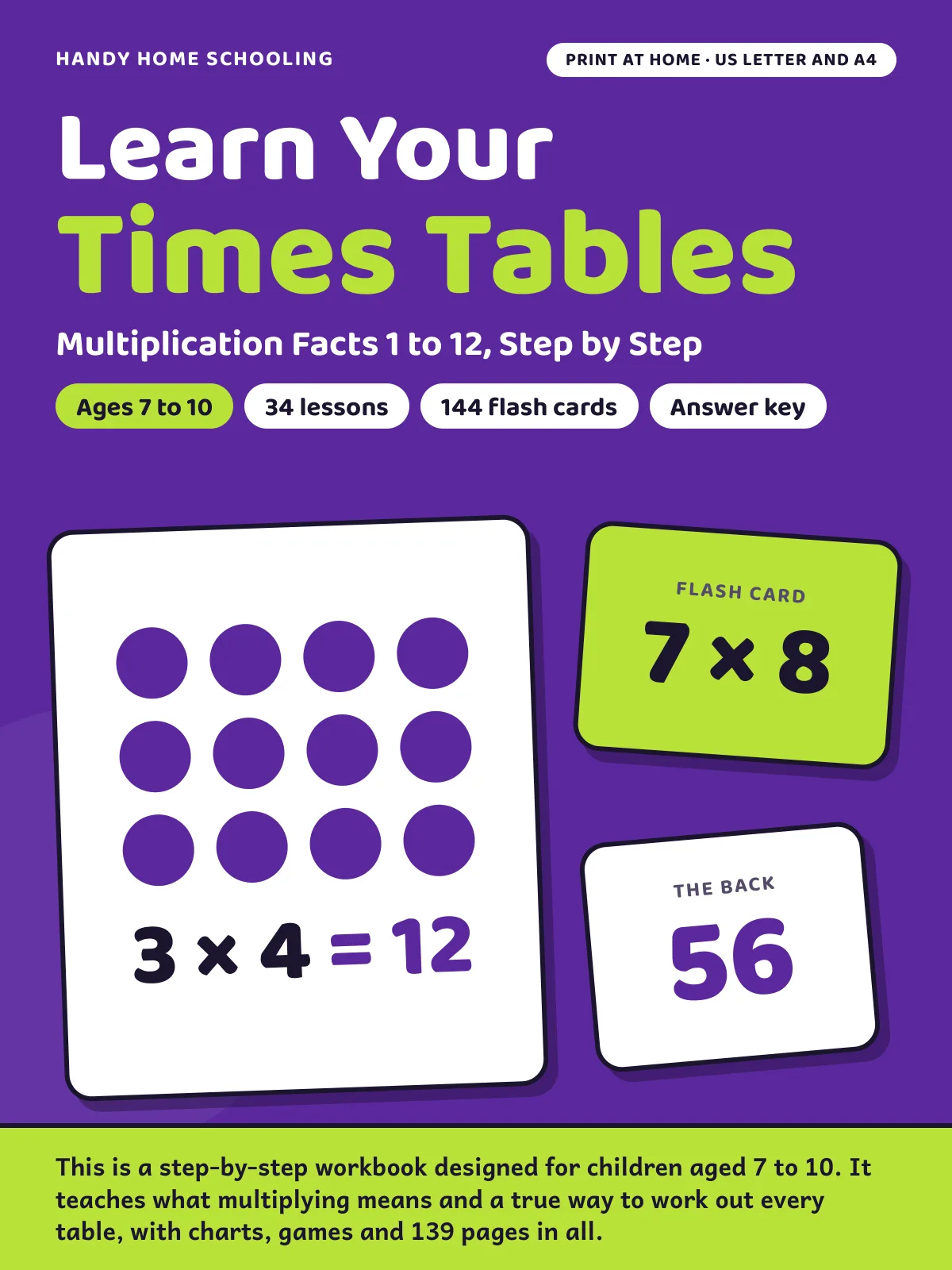 Item 1495
Learn Your Times Tables: Multiplication Facts 1 to 12, Step by Step
Handy Home Schooling
$12.99Was $19.99 Item 1496
Learn to Spell: 36 Weeks of Spelling Lessons, Step by Step
Handy Home Schooling
$12.99Was $19.99