Look inside
Learn to Spell: 36 Weeks of Spelling Lessons, Step by Step
For grades 1 and 2 (ages 6 to 8): each week teaches one spelling pattern and its rule, with word cards, letter tiles, tests and an answer key
Price
$12.99Was $19.99
Buying opens soon. Nothing on Bookstorez is on sale yet.
Look inside
What you get
| File | Format | Size |
|---|---|---|
| learn-to-spell-screen-letter.pdf | 5.9 MB | |
| learn-to-spell-screen-a4.pdf | 5.8 MB | |
| learn-to-spell-parent-record-fillable-letter.pdf | 159.5 KB | |
| learn-to-spell-parent-record-fillable-a4.pdf | 156.3 KB | |
| learn-to-spell-print-edition.zip | ZIP | 12.0 MB |
| Pages | 198 pages | |
About this product
This is a spelling course designed for children in grades 1 and 2 (ages 6 to 8), taught at home by a parent. It has 36 weekly lessons. Each week teaches one spelling pattern and the rule behind it, so your child learns how words are built and does not have to memorize lists. You need no training: every week has a page that tells you what to say. 198 pages.
Most spelling workbooks are lists and blank lines. This one teaches. Every week starts with a lesson page for your child: a picture, the idea in three sentences, the rule in a yellow box, two worked examples shown step by step, two words to finish with you, and an honest note on the common words that break the rule.
How you use it, day to day (10 to 15 minutes, five days a week)
- Day 1: read the lesson page together, then your child sorts the week's words.
- Day 2: you say six words and your child writes the missing letters, then builds four words with letter tiles. In later weeks: word sums such as hop + ing.
- Day 3: look, say, cover, write, check, for the week's 12 or 13 words.
- Day 4: dictation. Two sentences that use only what has been taught so far.
- Day 5: the Friday test, then your child colors the words on the tracker.
After every six weeks there is a review page and a check-up. Half of the check-up words are new to your child, so you see whether the pattern has been learned and not just the list.
What the 36 weeks teach, in order
- Weeks 1 to 6: the five short vowels, and c or k at the start of a word.
- Weeks 7 to 12: ck, the doubled letters ff, ll, ss and zz, sh, ch, th and wh, and tch.
- Weeks 13 to 18: ng and nk, blends at the end and the start of a word, and silent e for each vowel.
- Weeks 19 to 24: the vowel teams ee and ea, ai and ay, oa and ow, igh and y, oo, ou and ow.
- Weeks 25 to 30: oi and oy, ar and or, er, ir and ur, adding s and es, adding ing and ed, and when to double the last letter.
- Weeks 31 to 36: dropping a silent e, changing y to i, contractions, compound words, and homophones such as to, too and two and there, their and they're.
- Plus two or three tricky words every week (said, was, because), 79 in all, each with its tricky part marked.
What is inside (198 pages)
- Start here (12 pages): how a week works, a lesson page and a work page filled in as examples, the whole course on two pages, how to teach a spelling, how to teach tricky words, what to do about each kind of mistake, questions parents ask, and a ten-minute placement test so a child who spells some words already can start part-way through.
- 36 weeks, four pages each (144 pages): a page for you (what you are teaching, a script, the plan for each day, the dictation sentences, the test order, the mistakes to expect and what to do), the child's lesson page, and two work pages.
- 6 reviews and 6 check-ups (12 pages).
- Tools (20 pages): what to read out at each check-up, a progress chart, the rules at a glance on three pages for your wall, four games and a game board, 144 letter and pattern tiles to cut out, 79 tricky-word cards, a "Words I can spell" tracker, and a certificate.
- Answer key (7 pages), sources and file notes.
Every word is checked. The words, rules and sentences are held as data, and a program tests them each time the book is built. Every one of the 360 list words must contain its week's pattern with the right sound, checked against an American pronunciation dictionary. Every rule is tested over every word in the book, and a word that breaks a rule must be named on the lesson page as an exception. Every dictation sentence uses only patterns taught by that week, plus the tricky words taught so far. Homophones are checked to sound alike. The answer key is produced from the same data as the pages.
Where the method comes from. The rules, the order of teaching and the activities (sound boxes, word sorts, letter tiles, dictation, learning a tricky word by its tricky part) follow published guidance: the spelling appendix of England's national curriculum, the Institute of Education Sciences practice guide on foundational reading skills, the International Dyslexia Association's fact sheet on spelling, and Reading Rockets. The sources are listed at the back, and the passages relied on were checked word for word against saved copies.
What it does not do
- It makes no promise about how fast your child will learn, and it names no spelling age or grade level reached.
- It does not assess or diagnose learning difficulties. One page says when to ask a teacher or a reading specialist.
- It does not cover soft c and g, endings such as tion and ful, or long words of three or more beats. Those come the year after.
- It is not a handwriting program or a phonics program for reading. Your child should know the letter sounds before starting.
What you download
- The book in US Letter and A4, in color, for a screen or a color printer, with linked contents.
- The parent record (placement record, progress chart, check-up scores) as a fillable PDF in both sizes: type into it and save.
- One ZIP with the low-ink print edition in both sizes (white pages; every page for your child prints clean in black and white) and the Start here page.
- You need only one paper size: Letter for the USA and Canada, A4 for almost everywhere else.
Good to know
- American spelling and American words on every page (color, math, gray).
- You print about three pages a week for your child, single-sided. The tiles and cards are printed once.
- The text was written with the help of AI tools and checked as described above. The 36 pictures were drawn for this book.
- General educational material for parents. It is not professional advice about your child.
- If you print, choose 100% or "actual size", not "fit to page".
Contents
- Cover
- Start here
- What this is and how to use it
- The 36 weeks at a glance
- How to teach a spelling
- Placement test
- Unit 1 · Short vowels, and c or k
- Weeks 1 to 6: the lessons
- Review 1 and check-up 1
- Unit 2 · ck, doubled letters, sh, ch, th and tch
- Weeks 7 to 12: the lessons
- Review 2 and check-up 2
- Unit 3 · ng and nk, blends and silent e
- Weeks 13 to 18: the lessons
- Review 3 and check-up 3
- Unit 4 · Vowel teams
- Weeks 19 to 24: the lessons
- Review 4 and check-up 4
- Unit 5 · oi and oy, vowels with r, first endings
- Weeks 25 to 30: the lessons
- Review 5 and check-up 5
- Unit 6 · More endings, contractions, homophones
- Weeks 31 to 36: the lessons
- Review 6 and check-up 6
- Tools
- Check-ups and progress chart
- The rules at a glance
- Four games and a game board
- Tiles and tricky-word cards to cut out
- Words I can spell, and the certificate
- Answers and sources
- Answer key
- Sources and file notes
Category: Workbooks
Topics: Spelling rules · Phonics and decoding · Early childhood education
AI-assisted
More from Handy Home Schooling
 Item 1493
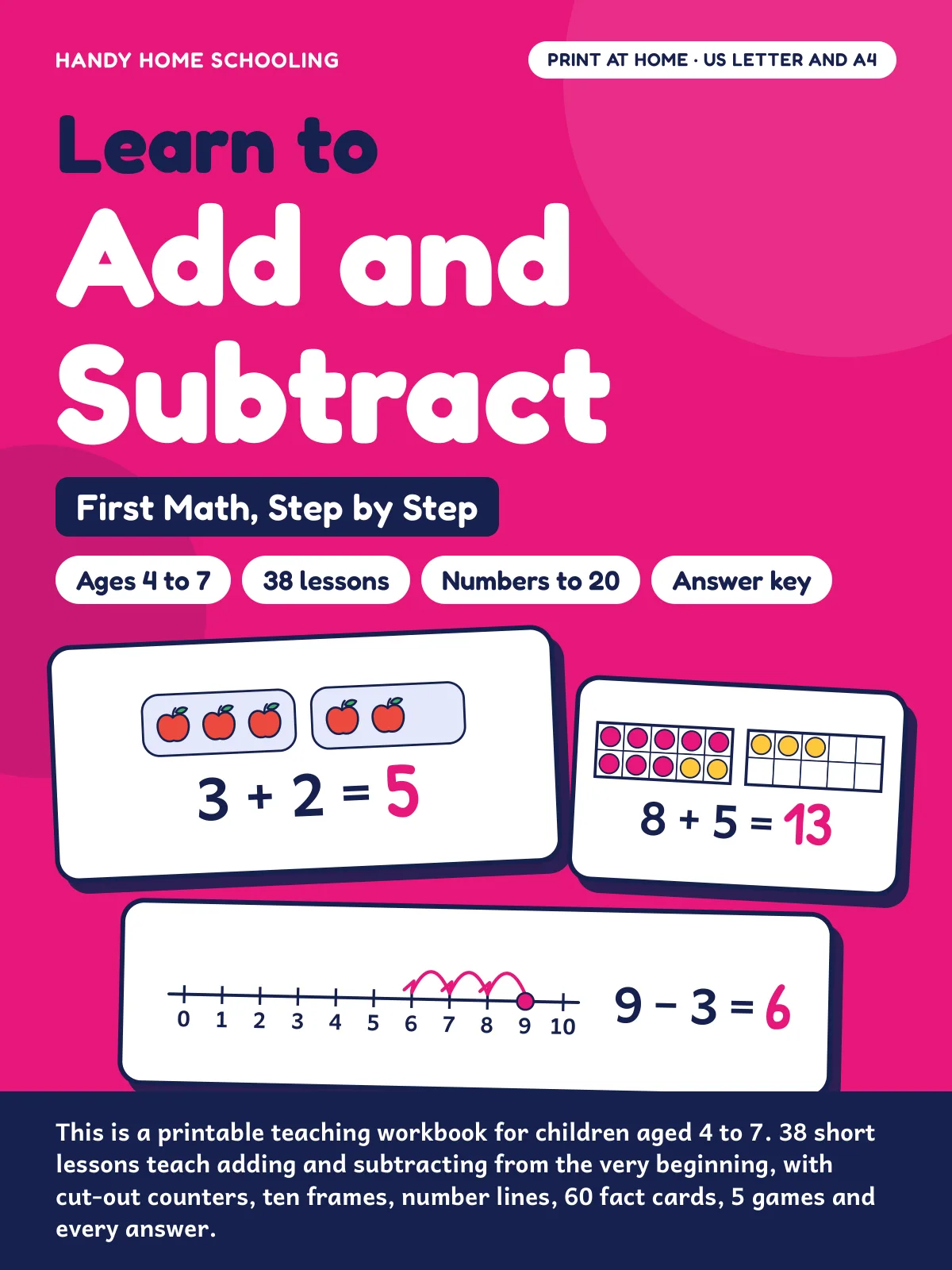
Learn to Add and Subtract: First Math, Step by Step
Handy Home Schooling
$12.99Was $19.99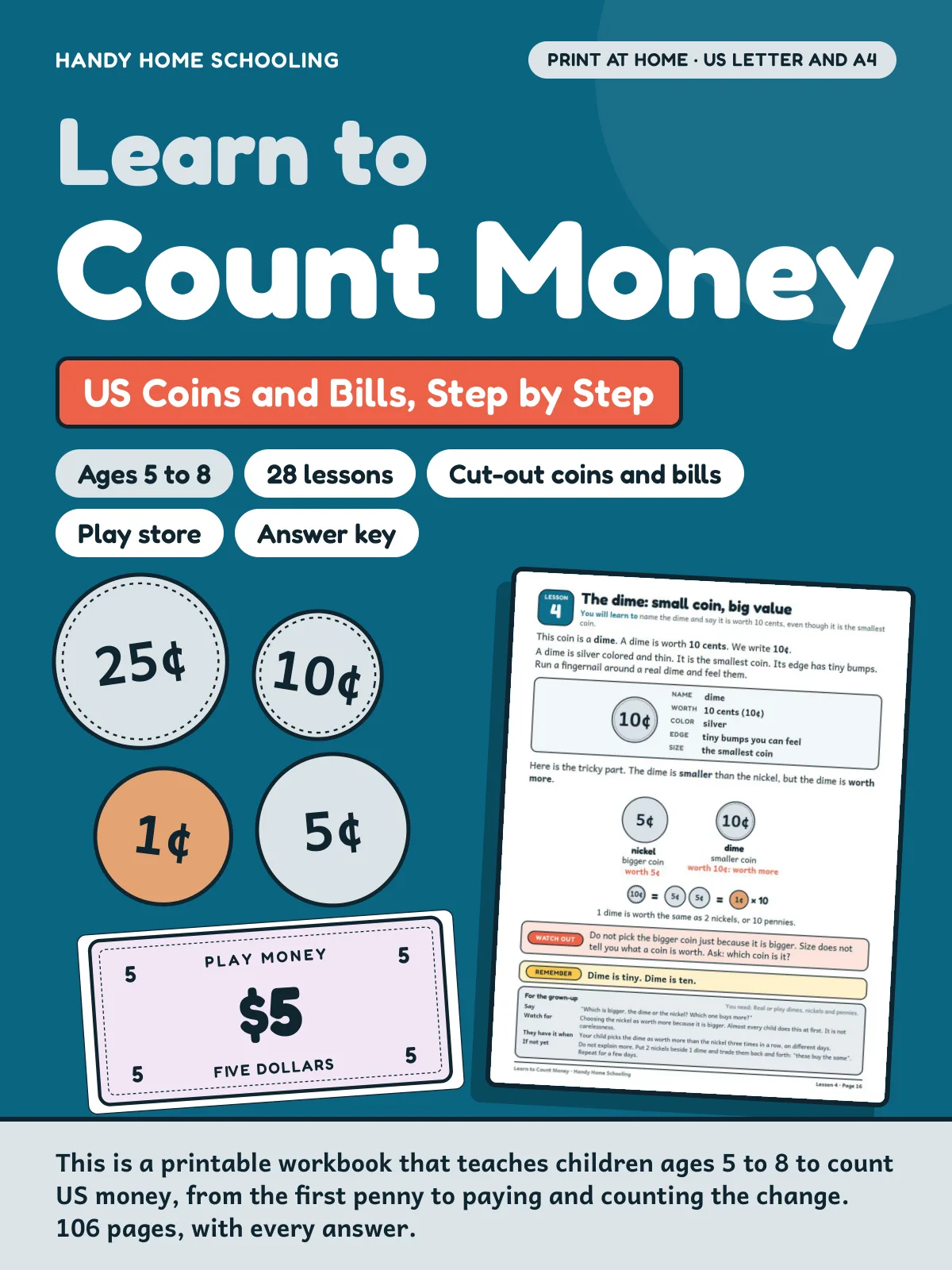 Item 1494
Learn to Count Money: US Coins and Bills, Step by Step
Handy Home Schooling
$12.99Was $19.99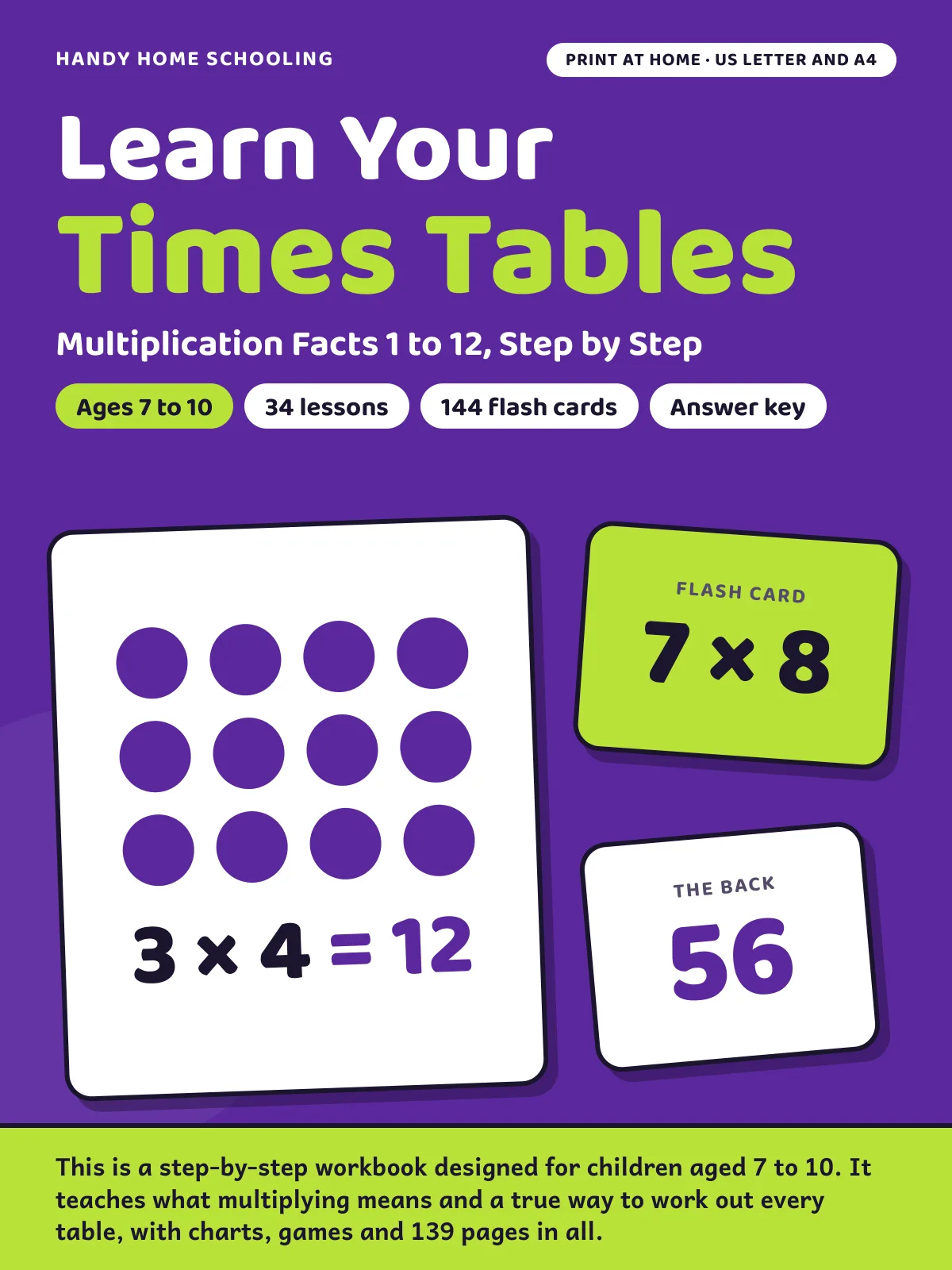 Item 1495
Learn Your Times Tables: Multiplication Facts 1 to 12, Step by Step
Handy Home Schooling
$12.99Was $19.99 Item 1492
Learn to Tell the Time: A Step-by-Step Workbook for Kids
Handy Home Schooling
$12.99Was $19.99