
Look inside
Teaching Your Child to Read at Home: A Parent's Guide to Phonics, Step by Step
For ages 4 to 8: the order to teach the sounds, daily 15-minute lessons, with word lists, decodable sentences and stories for every step
Price
$12.99Was $19.99
Buying opens soon. Nothing on Bookstorez is on sale yet.
Look inside
What you get
| File | Format | Size |
|---|---|---|
| phonics-at-home-parent-guide-screen-letter.pdf | 2.6 MB | |
| phonics-at-home-parent-guide-screen-a4.pdf | 2.6 MB | |
| phonics-at-home-parent-guide-parent-record-fillable-letter.pdf | 111.5 KB | |
| phonics-at-home-parent-guide-parent-record-fillable-a4.pdf | 111.5 KB | |
| phonics-at-home-parent-guide-print-edition.zip | ZIP | 4.5 MB |
| Pages | 109 pages | |
About this product
This is a step-by-step phonics guide designed for parents teaching a child of about 4 to 8 to read at home. You need no training. It tells you which sounds to teach and in what order, gives you one 15-minute lesson to repeat each day, and holds every word, sentence and story your child reads along the way. 109 pages, 32 steps.
Most phonics material is written for classroom teachers. This is the same structured, systematic approach, explained for one parent and one child at the kitchen table: what to say, what your child does, and what to do when it goes wrong.
How you use it, day to day
- Read Part 1 once. It explains how reading works, how to say each sound, and what to do when it is hard.
- Find your starting step. A beginner starts at step 1; for a child who already reads a little there is a ten-minute placement check.
- Print the two pages of that step, with its sound cards and the blending mat.
- Teach the 15-minute lesson on the left-hand page: review, new sound, blend, read, write. Your child reads from the right-hand page.
- Use the quick check at the foot of the page. When your child passes it, mark the date on the tracker and go on.
What is inside (109 pages)
- Start here: the method in six pages, with the 15-minute lesson explained, one lesson worked through word for word, and the whole sequence on two pages.
- Part 1, what you need to know (13 pages): how reading works in plain words, with diagrams; the terms explained once (phoneme, grapheme, digraph, blend, decodable, heart word); a chart of every sound with a key word, a drawn picture and how to say it; saying sounds cleanly; signs that a child is ready; heart words; what to do when it is hard; when to seek advice.
- Part 2, the sequence (65 pages): one page on how the two pages of a step work, then 32 steps in 7 stages, each a pair of facing pages: single letter sounds and three-sound words, sh, ch, th and ng, blends, silent e, vowel teams, vowels with r, soft c and g, the endings -ing, -ed, -es, -er and -est, and two-syllable words. Each step has a teaching page (what to teach, the scripted lesson, the words to build and to write, what to do if it is hard, a quick check) and a reading page for your child (a word list, six sentences and a tiny story).
- Part 3, tools (24 pages): a placement check, a progress tracker with a filled-in example, a blending mat, all 60 heart words with the tricky part marked, 12 games, 73 sound cards, 96 word cards and 60 heart-word cards to cut out, and the sources.
Every reading page is checked. The sequence, word lists, sentences and stories are held as data, and a program tests every word your child is asked to read (more than 5,800 in all) against a pronunciation dictionary. A word is on a page only if it can be sounded out with the spellings taught by that step, or is on that step's heart-word list. So your child is never asked to read something that has not been taught.
Where the method comes from. What the book says about how children learn to read, and the order of teaching, follows published guidance: the US National Reading Panel report, the Institute of Education Sciences practice guide on foundational reading skills, England's Department for Education reading framework and Letters and Sounds, Reading Rockets, the Florida Center for Reading Research and the International Dyslexia Association. The sources are listed at the back, and the passages relied on were checked word for word against saved copies.
What it does not do
- It makes no promise about how fast your child will read, and it gives no timetable.
- It does not diagnose reading difficulties. One page says when to ask a professional.
- It is not the whole of reading: you keep reading stories aloud to your child.
- It names and rates no commercial reading scheme.
What you download
- The book in US Letter and A4, for reading on a screen, with a linked map, sequence chart and sound chart.
- The parent record (progress tracker and placement record) as a fillable PDF in both sizes: type into it and save.
- One ZIP with the low-ink print edition in both sizes (white pages; the children's pages print clean in black and white) and the Start here page.
- You need only one paper size: Letter for the USA and Canada, A4 for almost everywhere else.
Good to know
- The children's pages use US spelling and US words (Mom), and the sounds were checked against a US pronunciation dictionary. A note explains what to do with the few words that differ in other accents.
- The reading pages are tiny on purpose: each uses only what has been taught so far, so the first stories have a handful of words.
- The text was written with the help of AI tools and checked as described above. The 45 pictures were drawn for this book.
- General information for parents. It is not professional, medical or legal advice.
- If you print, choose 100% or "actual size", not "fit to page".
Contents
- Cover
- Start here
- Start here
- Map of this book
- The 15-minute lesson
- One lesson, worked through
- The whole sequence: steps 1 to 16
- The whole sequence: steps 17 to 32
- Part 1 · What you need to know
- How reading works
- Sounds and letters
- Blending and segmenting
- The terms, explained once
- Sound chart: s to ck
- Sound chart: e to z
- Sound chart: two-letter sounds and vowel sounds
- Say the sounds cleanly
- Is my child ready, and where do we start?
- Heart words
- When it is hard
- When to seek advice
- Where this book's method comes from
- Part 2 · The sequence
- How a step works: the two pages
- Step 1: s, a, t, p
- Step 2: i, n, m, d
- Step 3: g, o, c, k
- Step 4: ck, e, u, r
- Step 5: h, b, f, l
- Step 6: j, v, w, x, y, z
- Step 7: qu and double letters
- Step 8: s at the end: cats, dogs
- Step 9: sh
- Step 10: ch and tch
- Step 11: th and wh
- Step 12: ng and nk
- Step 13: blends at the end
- Step 14: blends at the start
- Step 15: longer blends
- Step 16: he, go, my: a vowel at the end
Category: Ebooks
Topics: Early childhood reading · Homeschool planning · Letter recognition
AI-assisted
More from Handy Home Schooling
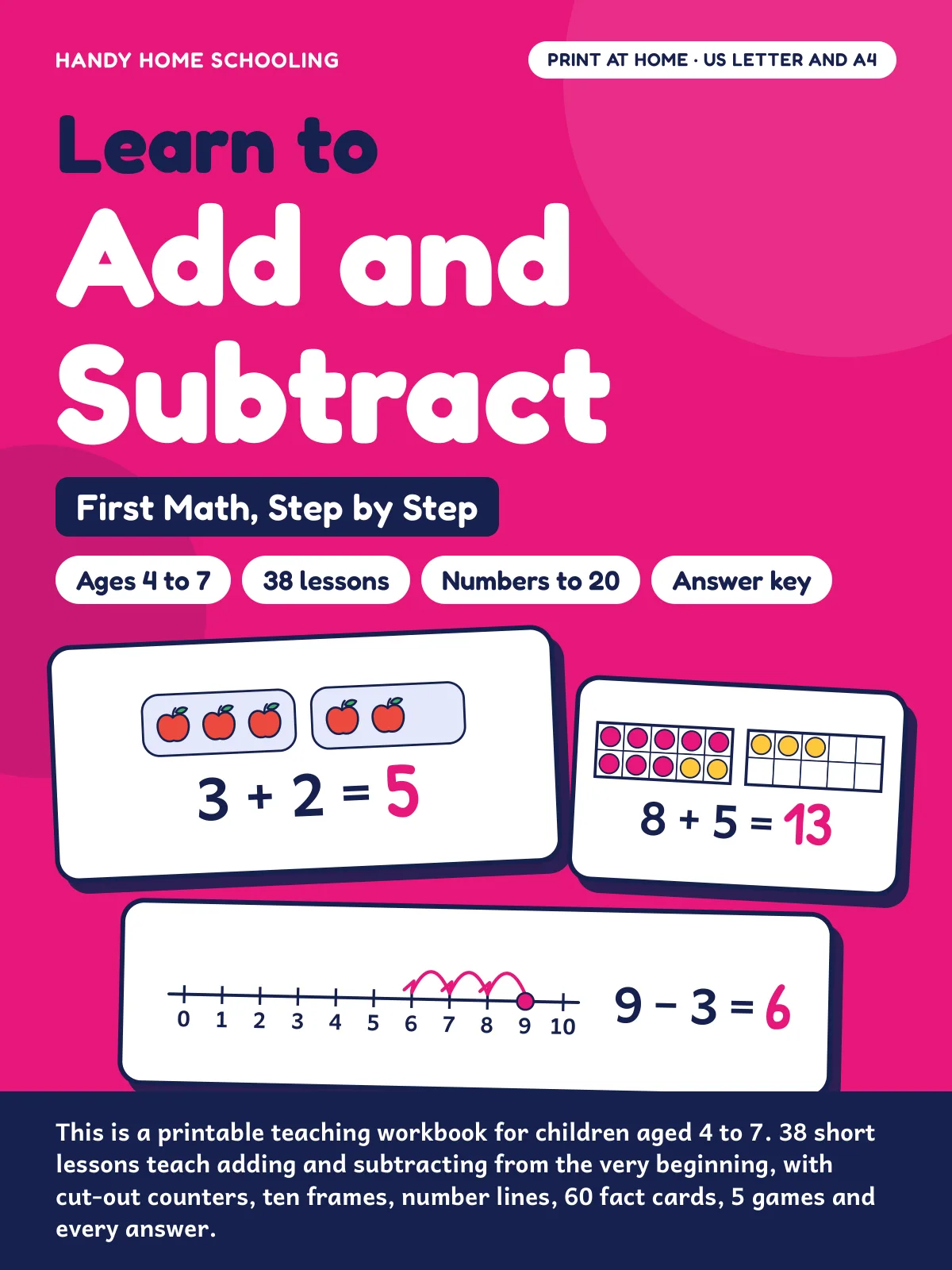 Item 1493
Learn to Add and Subtract: First Math, Step by Step
Handy Home Schooling
$12.99Was $19.99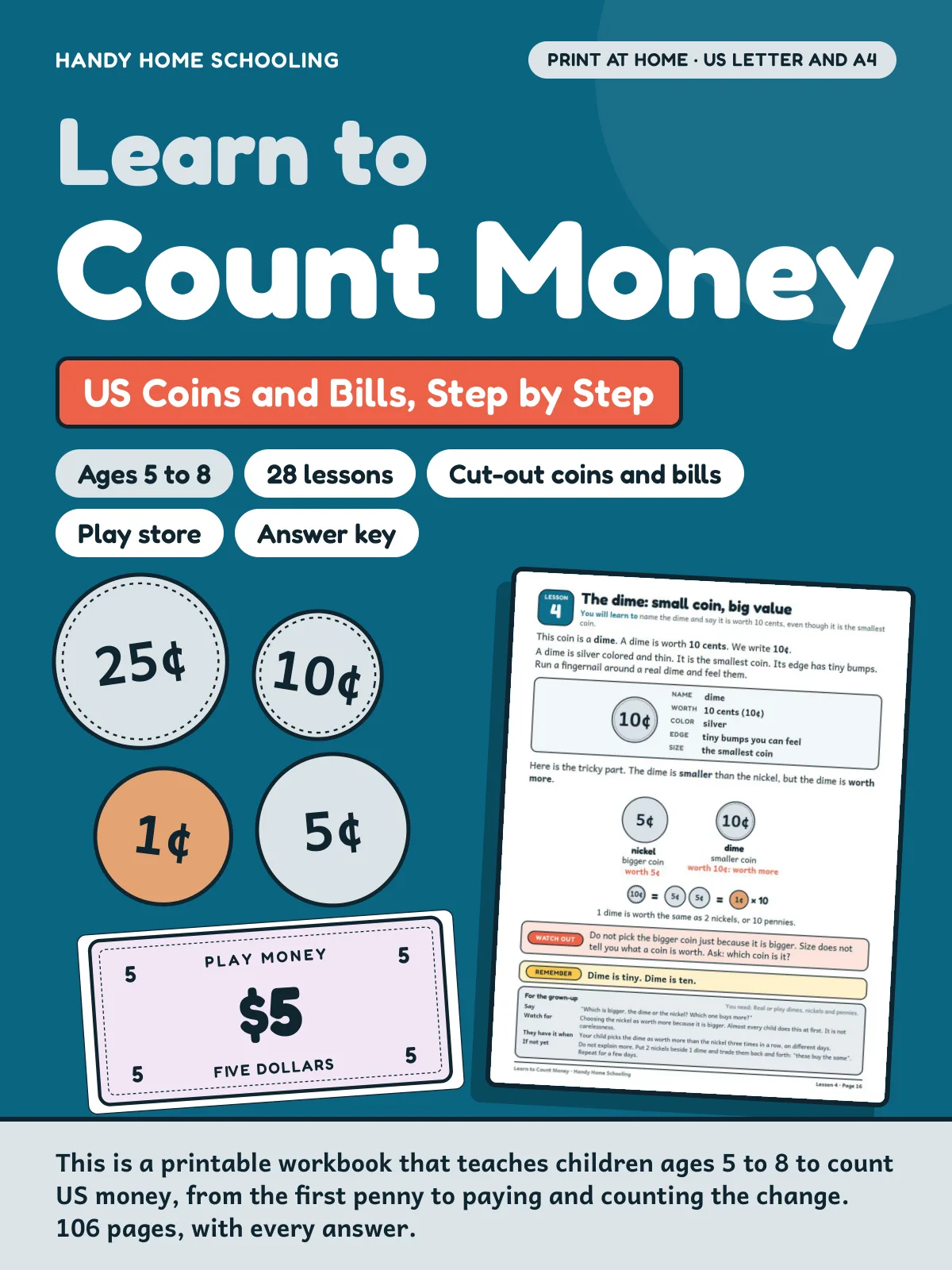 Item 1494
Learn to Count Money: US Coins and Bills, Step by Step
Handy Home Schooling
$12.99Was $19.99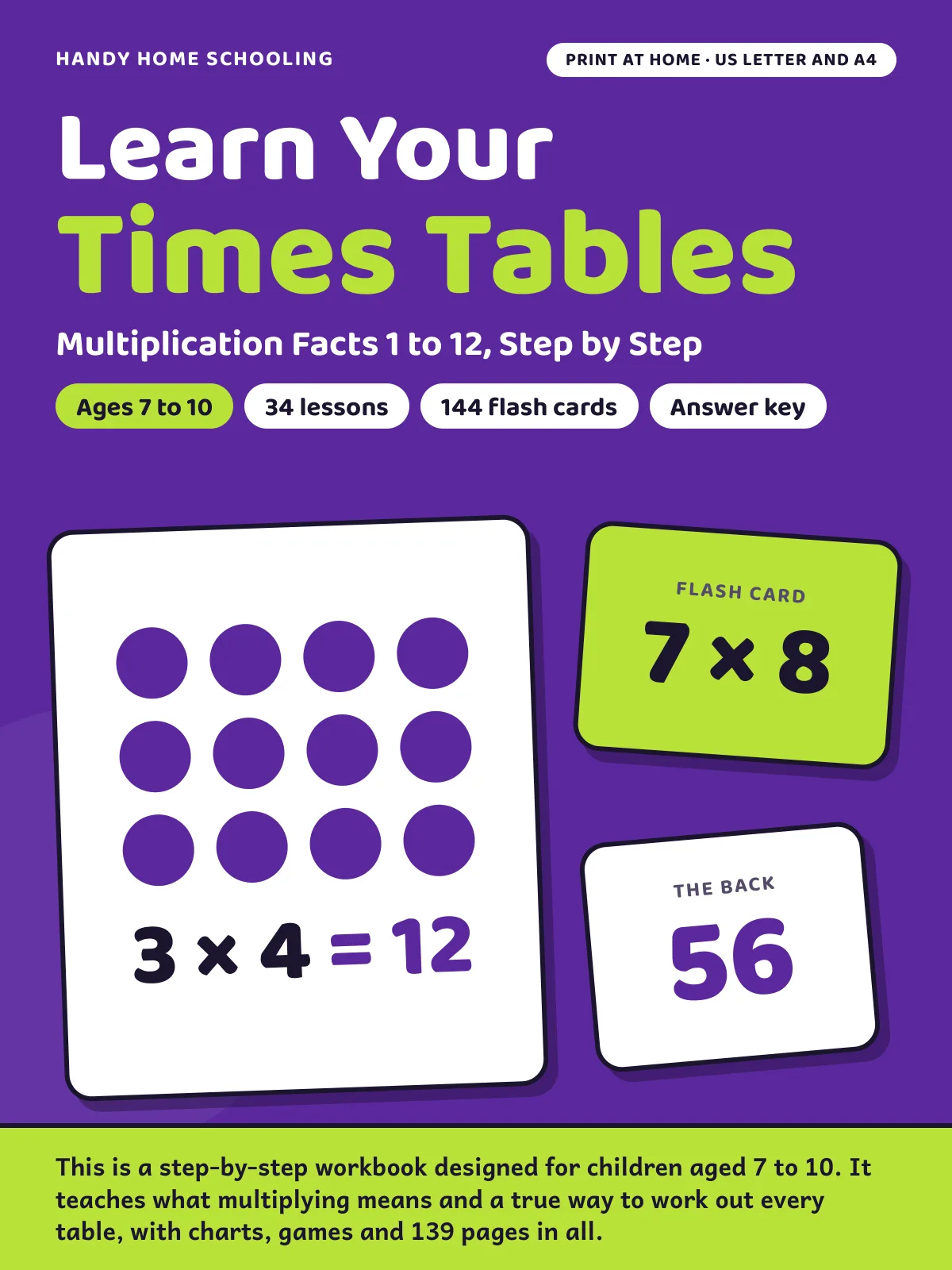 Item 1495
Learn Your Times Tables: Multiplication Facts 1 to 12, Step by Step
Handy Home Schooling
$12.99Was $19.99 Item 1496
Learn to Spell: 36 Weeks of Spelling Lessons, Step by Step
Handy Home Schooling
$12.99Was $19.99