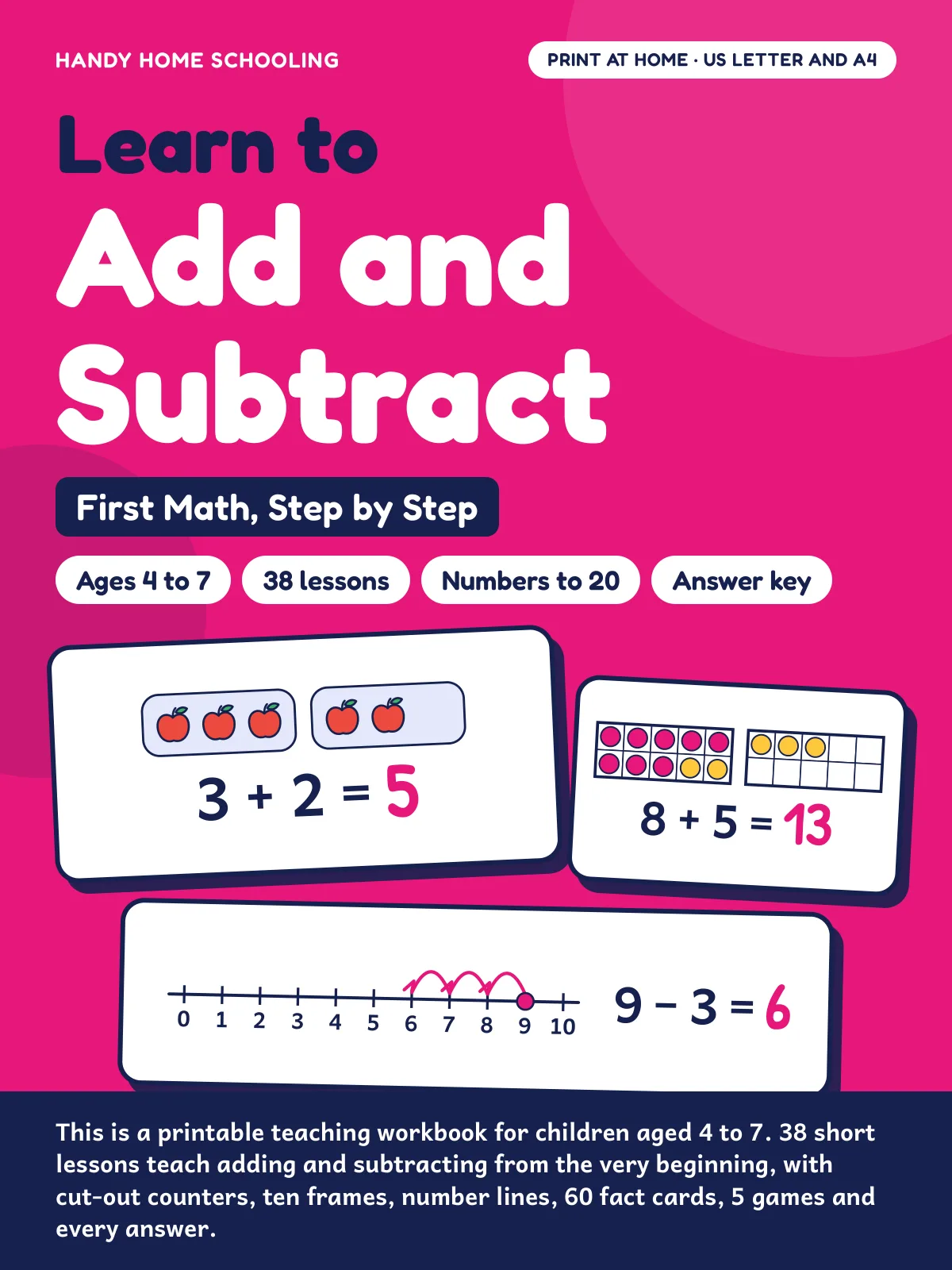
Times Tables: Beat Your Best
60 ten-minute practice days for ages 7 to 10: one strategy a week, a one-minute sprint every day, England's 25-question check in week 12, answers in the back
Order
Item 1632$18.00
Have a code?
If the file is faulty or not as described, you get a refund within 14 days.
What you get
| File | Format | Size |
|---|---|---|
| times-tables-beat-your-best.pdf | 7.2 MB | |
| Pages | 119 pages | |
Digital download. File formats, printing and download help.
About this product
A 12-week times tables practice course: one page a day, ten minutes, for a child of about 7 to 10.
This is for the child who has started the times tables and now needs them quick and reliable: for a timed test at school, for England's Year 4 multiplication tables check, or just so that long multiplication and fractions stop being a struggle. A parent runs it at home, or a teacher runs it with a class. Nobody needs to be good at maths: every strategy is spelled out, and every page is reprinted at the back with the answers in red.
How it works
- One table a week, in an order that builds. The 10s, 1s and 0s first; then the 2s and 5s; the 4s from the 2s; the 8s from the 4s; the 3s; the 9s from the 10s; the 6s from the 5s; the 7s from the 5s and 2s; the 11s and 12s. By week 8, most of the 7s are already known from other tables. Weeks 10 to 12 cover the tricky facts, division, and mixed checks.
- Two teaching pages every Monday. Real photographs of things in groups (pairs of socks, starfish arms, egg boxes, boxes of chocolates), the week's strategy worked step by step, the whole table with the facts already known shown in grey and the new ones in gold, the patterns to spot, the mistakes to watch for, and three out-and-about questions.
- A day page Monday to Friday, 60 in all. Warm up (eight facts from earlier weeks), Work it out (this week's strategy, every step in a box), an activity (count the groups in photographs, fill the gaps, fact families, or shade the route through a number grid), and a one-minute Sprint of 30 mixed facts.
- The Sprint is scored against the child's own best. Nobody is meant to finish. Right answers are counted, written beside the best so far, and ticked met it or beat it. The timer page sets out eight rules for using a timer without tears, drawn from a 2021 US Institute of Education Sciences practice guide, and what to do if a child dreads it.
- Fridays are different. An untimed Check-up of the week's table, a chart of the week's five Sprint scores, the slowest fact written on a card, and shading on the Fact Map.
- Week 12: four 25-question checks built to the published rules of England's multiplication tables check (2 to 12 times tables only, the 6, 7, 8, 9 and 12 tables weighted, no fact and its turnaround in the same check), with a strict version read aloud at six seconds a question and a steady version. A tally box shows which tables tripped the child.
By the end your child will
- answer every fact from 0 x 0 to 12 x 12 quickly and correctly
- work out any fact that slips from a fact they already know, instead of guessing
- use the same facts backwards to divide
- have a record of their own Sprint scores climbing, week by week
What is inside (119 pages, US Letter)
- Start here for the grown-up; the twelve-week plan on one page; three ways to know a fact; how a day works, with a day page shown; the timer rules; the shrinking square (why 144 facts are fewer than they look); a starting-line check that says which week to begin at; US and England side by side; running it with a class
- 12 weeks of teaching pages (26 pages) and 60 day pages
- A Fact Map to shade, a PB Board for Sprint scores, 24 cut-out cards for the tricky facts with the route to each on the back, a class tracker for 30 children, and a certificate
- Every day page and the starting-line check reprinted four to a page with the answers in red (17 pages), with a find-it-fast table
- Bookmarks for every week and every day
What you download
One PDF, 119 pages, in colour, US Letter size (8.5 x 11 in). The day pages print cleanly in black and white. On A4 paper, print with "fit to page". Print any page as often as you like for your own children or the children you teach; please do not share the file itself.
Good to know
- The book uses English spelling (maths, practise, colour) and gives both the England and US names for things, with a page comparing what each country expects and when.
- Every one of the 3,200 printed facts and answers was checked by a program against arithmetic, and each strategy chain was re-worked step by step.
- The rules of England's multiplication tables check are taken from the Standards and Testing Agency's published assessment framework and parents' leaflet. The book is not an official practice product and makes no promise about scores.
- This is a digital download. Nothing is posted to you, and you need a printer.
Contents
- Start here, for the grown-up
- The plan: twelve weeks, one table at a time
- Three ways to know a fact
- How a day works
- The timer: beat your best, not anyone else
- Watch the square shrink
- Where to start: the starting-line check
- US and England, side by side
- Running it with a class
- Week 1: the 10s, 1s and 0s (days 1 to 5)
- Week 2: the 2s and 5s (days 6 to 10)
- Week 3: the 4s (days 11 to 15)
- Week 4: the 8s (days 16 to 20)
- Week 5: the 3s (days 21 to 25)
- Week 6: the 9s (days 26 to 30)
- Week 7: the 6s (days 31 to 35)
- Week 8: the 7s (days 36 to 40)
- Week 9: the 11s and 12s (days 41 to 45)
- Week 10: squares and their neighbours, the tricky 24 (days 46 to 50)
- Week 11: division (days 51 to 55)
- Week 12: race day, four 25-question checks (days 56 to 60)
- Keep them for good
- Fact Map
- PB Board
- Cards: the tricky 24
- Class tracker
- Certificate
- Answers: every page, four to a page, in red
Category: Workbooks
AI-assisted