Where the Cards Fall
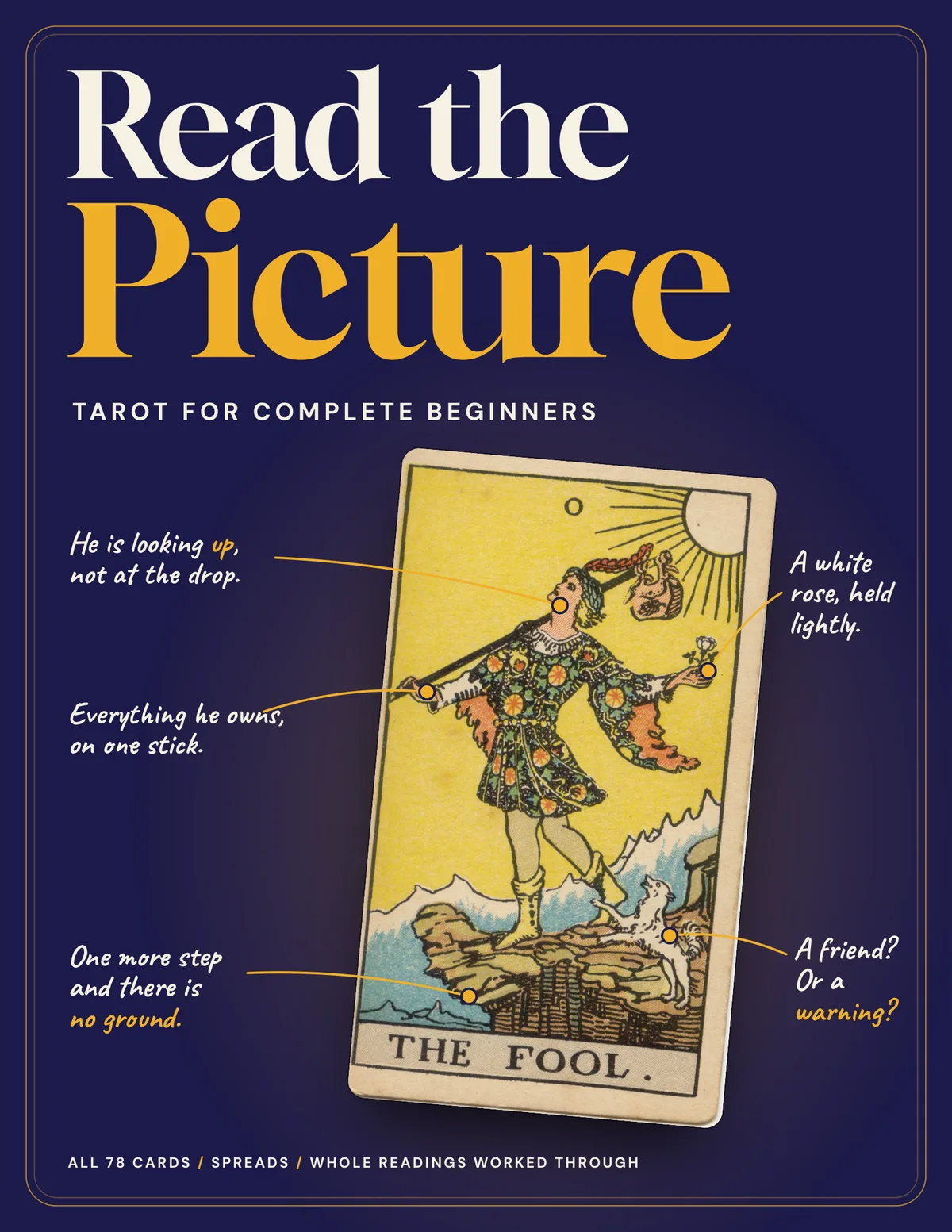
Tarot spreads for real questions: how to choose a spread, lay it out and read every position, with ten spreads worked through from question to answer
Order
Item 1598$15.00
Have a code?
If the file is faulty or not as described, you get a refund within 14 days.
What you get
| File | Format | Size |
|---|---|---|
| where-the-cards-fall.pdf | 10.4 MB | |
| where-the-cards-fall-spread-sheets-letter.pdf | 219.9 KB | |
| where-the-cards-fall-spread-sheets-a4.pdf | 221.7 KB | |
| Pages | 73 pages | |
Digital download. File formats, printing and download help.
About this product
You have a tarot deck and a question, and you freeze at the same place everyone does: which spread? The booklet in the box gives you one big ten-card spread and no help choosing. Spread books give you hundreds, as lists of positions, with no way to pick one and no help joining the cards into an answer.
This book is about that part in between: matching a spread to the question you actually have, laying it out, and reading the cards as one answer instead of a list of separate meanings.
It is written for someone who owns a deck and has done a few readings, or has never done one. It explains every term the first time it is used. You do not need to know all 78 cards by heart: a one-line meaning for every card is at the back.
What you will be able to do
- Turn a worry into a question a spread can help with, and spot the six ways questions usually go wrong.
- Pick the right spread for your question, and the right size, with a one-page spread finder.
- Read any card through the position it lands in.
- Read across the positions (pairs, lines, echoes, counts, where the figures look) so the cards add up to one answer.
- Fix a reading when a card will not fit its place, or the whole table makes no sense.
- Write your own spreads, and test them before you rely on them.
What is inside
- How a spread works. What every spread is made of, six shapes that tell you how positions relate, how many cards to use, and a three-pass method that reads any spread.
- Choose the spread. From worry to question, seven kinds of question, the spread finder, and when not to read at all.
- Ten spreads, smallest to biggest: one card, two cards, Three in a line, the Knot (for being stuck), the Fork (for a decision), the Bridge (you and one other person), the Horseshoe, the Month Ahead, the Year Behind and the Celtic Cross. Each has a page with its layout, every position as a question, when to use it and when to skip it, and the same shape worded for other parts of life.
- Eight whole readings with real cards. Each one shows the question the person first wrote and why it changed, the cards laid out, the whole table read first, every card read through its position, the links across positions, the answer in one sentence and what they did next. Before the end of each, you are asked to read the last cards yourself.
- The Celtic Cross, properly. Its positions in A. E. Waite's own words beside plain ones, how to read it as five pairs, and a table showing why different books number it differently.
- When a spread fights back. A card that will not fit, cards that seem to be in the wrong places, and a reading that is all noise.
- Build your own. Five steps, four checks every position must pass, one spread built from first draft to finished reading, and six broken positions to fix, with answers.
- Look it up. Every spread on one page, every card in one line, a reading record, a glossary and sources.
An honest note
This book treats tarot as a way of thinking a question through with pictures in front of you. It does not claim the cards predict the future, and it says plainly that a reading is no substitute for a doctor, a lawyer, a therapist or a financial adviser. The people in the readings are invented; the cards are scans of the original 1909 Rider-Waite-Smith deck by Pamela Colman Smith. Card meanings follow the ones most modern teachers give for that deck, and the sources page says where A. E. Waite differed. It suits the Rider-Waite-Smith deck and the many decks that copy it. It is a book about spreads: it gives each card a one-line meaning, not a full page. You need your own deck; none is included.
Your files
- Where the Cards Fall (PDF, 73 pages, US Letter). The whole book, with bookmarks and selectable text. Reads well on a tablet or laptop, and prints on US Letter or A4 with "fit to page".
- Spread sheets (PDF, 11 pages), in two copies: one sized for US Letter and one for A4. A sheet for each of the ten spreads with its layout and positions, a design-your-own sheet and a reading record, to print and write on by hand. They are not fillable forms.
This is a digital download. No physical book or deck is shipped.
Contents
- Start here
- How to use this book
- A card means what its position asks
- Part 1: How a spread works
- What a spread is made of
- The shape is part of the question
- How many cards?
- Read every spread in three passes
- Reading across the positions
- Counting, and where the figures look
- Significators, clarifiers and upside-down cards
- Part 2: Choose the spread for your question
- From worry to question
- Seven kinds of question
- The spread finder
- Before you lay a card
- Part 3: Ten spreads, each worked through
- One card and two cards
- Three in a line · worked: Dana's driving test
- The Knot · worked: Sam's garage
- The Fork · worked: Marcus and the promotion
- The Bridge · worked: Ruth and her sister
- The Horseshoe · worked: Tomás and the bread stall
- The Month Ahead · worked: Ivy's first month
- The Year Behind · worked: Graham's retirement
- The Celtic Cross: positions, five pairs, why the books disagree
- Worked: Ben's Celtic Cross
- Part 4: When a spread fights back
- A card that will not fit its position
- Right cards, wrong places?
- When the whole reading is noise
- Part 5: Build your own spread
- Five steps to a spread that works
- Worked: Priya builds a spread
- Fix these six positions, with answers
- A blank spread to design
- Look it up
- Every spread on one page · every card in one line
- Reading record · words you will meet · sources
Category: Guides
AI-assisted