
By Bookstorez · Updated
The phonics screening check is a short reading check that children in Year 1 at state-funded schools in England take in June. Your child reads 40 words aloud to a teacher they know: real words, and made-up "alien" words that show whether they can sound out a word they have never seen. In 2027 schools hold it in the week of Monday 14 June. The pass mark is set each year and published afterwards: 31 out of 40 in 2026, 32 in 2025. A child who does not reach it gets extra support and takes it again in Year 2. This guide explains each part from the Department for Education's own documents, then gives a ten-minute routine for practising at home.
At a glance / Real and alien words / The pass mark / Results and the Year 2 retake / Past papers / Practising at home
At a glance
| The 2027 check | |
|---|---|
| Who takes it | Children who turn 6 by the end of the school year and have finished the first year of key stage 1 English. Most are in Year 1. Children in Year 2 who have not taken it, or who did not meet the standard in 2026, take it too. |
| Where | State-funded schools in England: maintained schools, academies and free schools, and special schools. Wales, Scotland and Northern Ireland have their own arrangements. |
| When | Schools hold it in the week of Monday 14 June to Friday 18 June 2027. A child who is away that week can take it from Monday 21 to Friday 25 June. |
| What happens | Your child reads 40 single words aloud, one to one, to a teacher. Half are real words and half are made-up "pseudo-words". |
| The pass mark | Set each year and published after the check: on Monday 28 June 2027. It was 31 out of 40 in 2026 and 32 in 2025. |
| Results | The school must tell you your child's score by the end of the summer term in Year 1. |
| If the standard is not met | The school supports your child, and they take the check again in June of Year 2. |
Sources: Standards and Testing Agency, 2027 phonics screening check assessment and reporting arrangements; Phonics screening check: 2026 materials; Phonics screening check: 2025 materials. All checked 14 November 2026.
What the check is for
The Department for Education says the check is there "to confirm that all children have learned phonic decoding to an age appropriate standard", and to find the children who need extra help early, "so that they do not fall behind in this vital early reading skill" (Phonics screening check: information for parents, Standards and Testing Agency).
Decoding is what phonics teaches: knowing the sound each letter or group of letters makes (s, a, t, then sh, ee, igh and so on), then blending those sounds from left to right into a word. The check asks only that. It is not a test of reading for meaning, spelling or handwriting, and there is nothing to write.
It is also not an exam a child passes or fails in the usual sense. The DfE does not publish results for individual schools. A school uses its pupils' results to see who needs more support.
Real words and alien words
The 40 words come in two sections of 20, and each section mixes real words with pseudo-words: made-up words that follow phonics rules but mean nothing. Pseudo-words are there so a child cannot recognise a word from memory; the only way to read one is to decode it.
Every pseudo-word is printed next to a picture of an imaginary creature, often called an alien. Children are taught that a word with a creature beside it is not a real word, so they do not try to turn it into one they know. A child who reads a made-up word such as "tup" as "top" has not decoded it. (That example is ours, not from a check.)
If your child's school uses its own name for made-up words, use that word at home.
The pass mark
Each word read correctly scores a mark, so the check is out of 40. The mark needed to meet the expected standard, called the threshold, is not fixed in advance. The Standards and Testing Agency sets it each year and publishes it on GOV.UK after the check:
- 2025: 32 out of 40
- 2026: 31 out of 40
- 2027: to be published on Monday 28 June 2027
Schools send in their results without waiting for it.
How many children meet it? In 2026, 82% of pupils met the expected standard in Year 1, up from 80% in 2025, and 89% had met it by the end of Year 2. Girls did better than boys (86% against 78%) (Phonics screening check attainment, 2025/26, Department for Education).
Results and the Year 2 retake
By the end of the summer term in Year 1 the headteacher must tell you your child's score, or tell you if they were absent or did not take the check, and why. The parents' leaflet says to expect it in the second half of the summer term.
If your child did not reach the threshold, the school should tell you what support it has put in place. Schools are expected to keep a programme of support going, and your child takes the check again in June of Year 2. You are told that result too.
A score just under the line often means a few sounds are not secure yet, and that is exactly what the check is meant to find. Ask the teacher which sounds or kinds of word tripped your child up: it is the most useful thing to practise.
Past papers
The Standards and Testing Agency publishes every year's check after it has been used, with the pupil materials (the words as children see them), the scoring guidance and the answer sheet. Search GOV.UK for "phonics screening check materials", or start from the 2026 materials.
They are useful at home in small doses. Read five or ten words together rather than all 40 at once, and use them to find which sounds need work, not to rehearse a test.
Practising at home
The parents' leaflet asks for two things: encouragement and enjoyment of books, and sounding out. When your child meets a word they do not know, encourage them to "sound out" and then blend the sounds together from left to right, rather than looking at the pictures to guess. Ask the teacher for "decodable readers", books written with the letters and sounds your child has learnt.
A ten-minute routine (our suggestion, not a DfE one):
- Two minutes of sounds. Show the letters and letter groups from this week's lessons and say the sounds together. The class teacher can tell you which order the school's phonics programme uses.
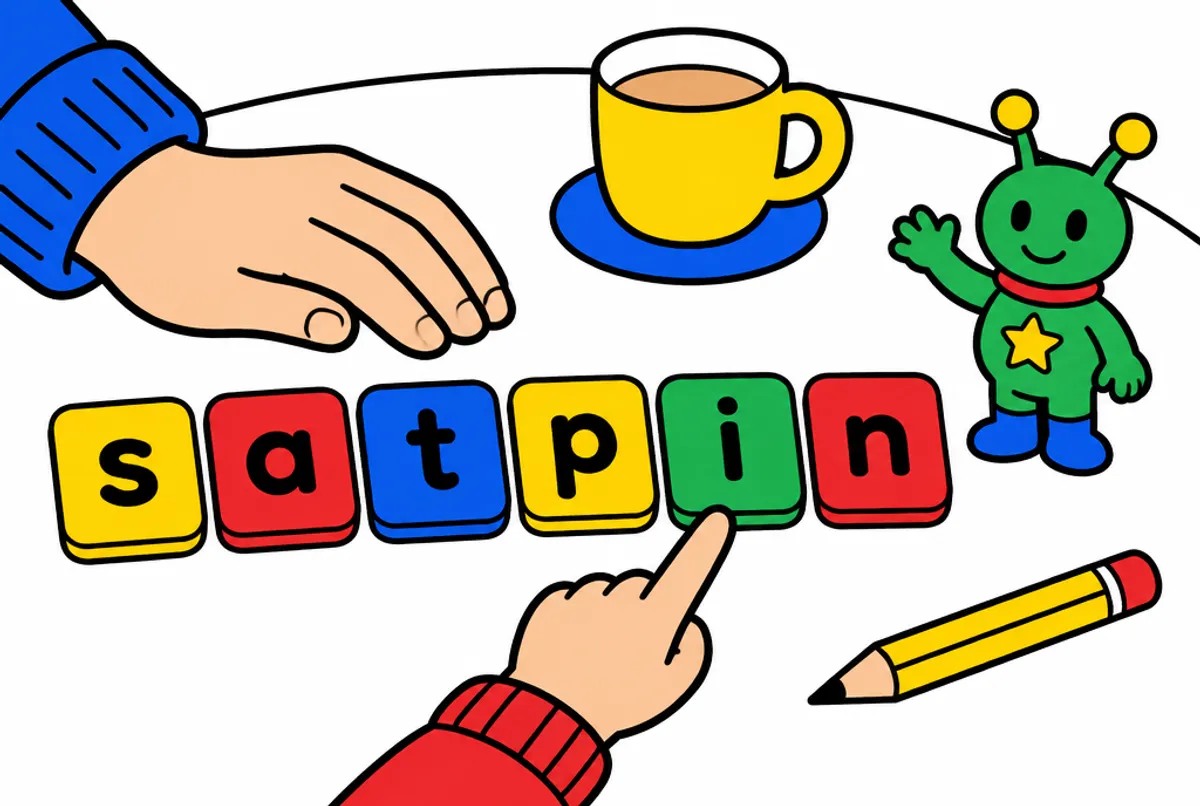
- Three minutes of blending. Point under each sound in a short word, say each one, then run them together: s-a-t, sat. Move on to words with two-letter sounds: sh-o-p, r-ai-n.
- Two minutes of alien words. Make up nonsense words with letter tiles or cards, such as "vop" or "steeb", and read them as alien names. It is the best practice for the pseudo-words, because your child cannot guess.
- Three minutes of a book. Read a decodable book or a page of the reading-record book together, then talk about what it meant.
Little and often works better than a long session before the check. If your child is tired or upset, stop: the check is a short one-to-one session with a teacher they know, and it should not feel like an exam at home either.
Books and printables that help
If you want a structured plan for teaching sounds at home, Teaching Your Child to Read at Home: A Parent's Guide to Phonics, Step by Step sets out the order to teach the sounds with a 15-minute daily lesson, word lists and decodable stories. More phonics and early reading downloads are on phonics and decoding and early childhood reading. These are books by independent creators on Bookstorez, not Department for Education materials; check each one's sample pages and age range before buying.
Sources
- Standards and Testing Agency, 2027 phonics screening check assessment and reporting arrangements
- Standards and Testing Agency, Phonics screening check: information for parents
- Standards and Testing Agency, Phonics screening check: 2026 materials and 2025 materials
- Department for Education, Phonics screening check attainment, 2025/26
Questions
- When is the phonics screening check in 2027?
- Schools hold it in the week of Monday 14 June to Friday 18 June 2027. A child who is absent that week can take it between Monday 21 and Friday 25 June. The 2027 pass mark is published on GOV.UK on Monday 28 June 2027.
- What is the pass mark for the phonics screening check?
- The threshold is set each year after the check. It was 31 out of 40 in 2026 and 32 out of 40 in 2025. Each word read correctly scores one mark.
- What are alien words in the phonics check?
- They are pseudo-words: made-up words that follow phonics rules but have no meaning. Each one is printed next to a picture of an imaginary creature, so children know it is not a real word and decode it instead of guessing.
- What happens if my child does not pass the phonics screening check?
- The school should tell you what support it is giving your child, and your child takes the check again in June of Year 2. You are told that result too. The check is there to find children who need more help, not to label them.
- When will I get my child's phonics check result?
- The headteacher must tell you your child's score by the end of the summer term in Year 1. The DfE's leaflet for parents says to expect it in the second half of the summer term.
- Where can I find phonics screening check past papers?
- The Standards and Testing Agency publishes each year's materials on GOV.UK after the check: the pupils' words, the scoring guidance and the answer sheet. Search GOV.UK for phonics screening check materials, for example the 2026 materials.
- Do children in Wales or Scotland take the phonics screening check?
- No. It is a statutory check for state-funded schools in England. Wales, Scotland and Northern Ireland have their own assessment arrangements.