
Look inside
A Short History of AI: From the First Thinking Machines to ChatGPT and Beyond (2026 Edition)
A short, illustrated history of artificial intelligence, designed for curious readers with no technical background
By AI Project
Price
$19.99Was $29.99
Buying opens soon. Nothing on Bookstorez is on sale yet.
Look inside
What you get
| File | Format | Size |
|---|---|---|
| short-history-of-ai-screen-letter.pdf | 3.2 MB | |
| short-history-of-ai-screen-a4.pdf | 3.3 MB | |
| short-history-of-ai-print-edition.zip | ZIP | 6.7 MB |
| Pages | 62 pages | |
About this product
This is a short, illustrated history of artificial intelligence, designed for curious readers with no technical background. If you use an AI assistant and have wondered where it came from, this book tells you. 2026 edition: 62 pages, 16 chapters, 8 one-page explainers with diagrams, 1 master timeline.
Most people met AI in late 2022, when ChatGPT appeared. The story is much older. It starts with a note written in 1843, runs through a famous question in 1950 and a summer workshop in 1956, two long periods when the money dried up, a chess match, a quiz show, a board game, and one research paper in 2017 that every chat assistant today descends from. This book tells that story in order, in plain words, with a timeline along the foot of every chapter page so you always know where you are.
Every date, name, number and quotation is sourced. Each one was read on a published source in October 2026: original papers, the makers' own announcements, museums, universities, encyclopedias and major news outlets, 128 pages in all, listed at the back. A program checked the finished pages against that record every time the book was built. What could not be sourced was left out.
How you use it
- Look at the one-page map and the whole story on one page.
- Read the chapters in order, or go straight to the era you are curious about. Each chapter opens with an "in one paragraph" summary.
- Stop at the explainers when you want to know how something works.
- Keep the master timeline, glossary and ten questions for later.
What is inside (62 pages)
- Start here, a map of the book and the whole story on one page.
- Beginnings (chapters 1 to 3): the idea before the machines, Alan Turing and his 1950 question, and the 1956 Dartmouth workshop that gave the field its name.
- Boom and bust (chapters 4 to 6): the early programs and early optimism, the first AI winter, expert systems and the second winter.
- Machines that learn (chapters 7 to 9): the quiet rise of machine learning, games as milestones (checkers, chess and Deep Blue, Jeopardy!, Go and AlphaGo), and deep learning's breakthrough in 2012.
- The language turn (chapters 10 to 13): the 2017 transformer paper, large language models and the release of ChatGPT, the assistants race from 2023 to 2026 (ChatGPT, Claude, Gemini, Copilot, Grok, and the main open and Chinese models), and the generation of pictures, voices and video.
- The world reacts (chapters 14 to 16): what changed in work and school, the five big arguments (jobs, copyright, bias, safety, energy) with the main positions set out fairly and no verdicts, and what is and is not known about what comes next, marked as open questions and not as predictions.
- Eight one-page explainers with diagrams: the imitation game, what a neural network is, what training means, the scoreboard of machines against champions, what a transformer does in plain words, what a large language model predicts, the assistants race on one page, and how a picture is made from noise.
- Reference: a two-page master timeline, a who's who of 30 entries, a glossary of 46 terms, how to read AI news without being fooled (ten questions to ask), further reading, and the sources.
What it does not do
- It does not teach you to use any particular assistant, and it recommends none.
- It does not predict the future or promise any result.
- It does not take a side in the arguments about AI.
- It has no photographs of people and no company logos. The pictures are drawings, diagrams and timelines.
What you download
- The book in US Letter and A4, for reading on a screen, with a linked map, page references and bookmarks.
- One ZIP with the low-ink print edition in both sizes (white pages, light on ink) and the Start here page.
- You need only one paper size: Letter for the USA and Canada, A4 for almost everywhere else.
Good to know
- Independent publication. Not affiliated with or endorsed by any AI company.
- 2026 edition, checked October 2026. The history up to about 2020 is settled. The last chapters cover events that are still moving: new models are released every few months and court cases are still being decided. The dates given will stay correct; the answer to "what is the newest?" will not.
- A few facts rest on encyclopedia articles and transcriptions and not on the original document. The sources pages say which.
- The eight chapter illustrations were made with an AI image tool. The text was written with the help of AI tools and checked against the sources listed.
- General information for the curious reader. It is not professional, legal or financial advice.
- If you print, choose 100% or "actual size", not "fit to page".
Contents
- Cover
- Start here
- Start here
- Map of this book, and contents
- The whole story on one page
- 1 · The idea
- The idea before the machines
- Logic, robots and brain cells
- 2 · Turing's question
- Turing and the 1950 question
- Explainer: The imitation game
- A forecast, and nine objections
- 3 · The name
- Dartmouth 1956: the field gets a name
- One summer, and what it started
- 4 · Early optimism
- Early programs and early optimism
- Talking, seeing, moving
- Explainer: What a neural network is
- 5 · First winter
- The first AI winter
- The Lighthill report
- 6 · Expert systems
- Expert systems and the second winter
- The boom, and the second winter
- 7 · Machine learning
- The quiet rise of machine learning
- Explainer: What training means
- Data becomes the fuel
- 8 · Games
- Games as milestones
- A quiz show, and the oldest game
- Explainer: The scoreboard: machines and champions
- Starting from nothing
- 9 · Deep learning
- Deep learning breaks through
- From photographs to everything
- 10 · The transformer
- The 2017 transformer paper
- Explainer: What a transformer does, in plain words
More from AI Project
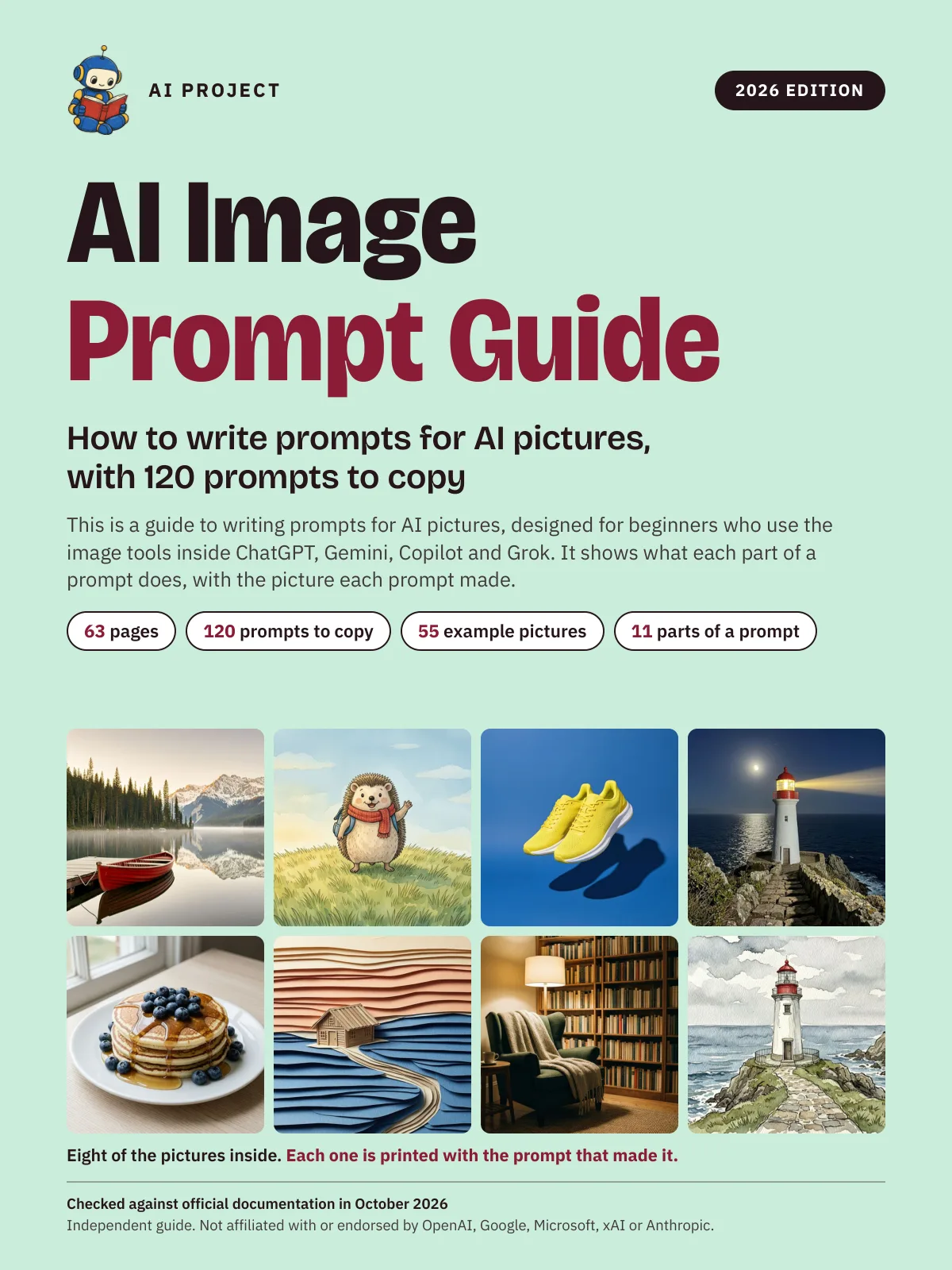 Item 1479
AI Image Prompt Guide: How to Write Prompts for AI Pictures, with 120 Prompts to Copy (2026 Edition)
AI Project
$9.99Was $15.99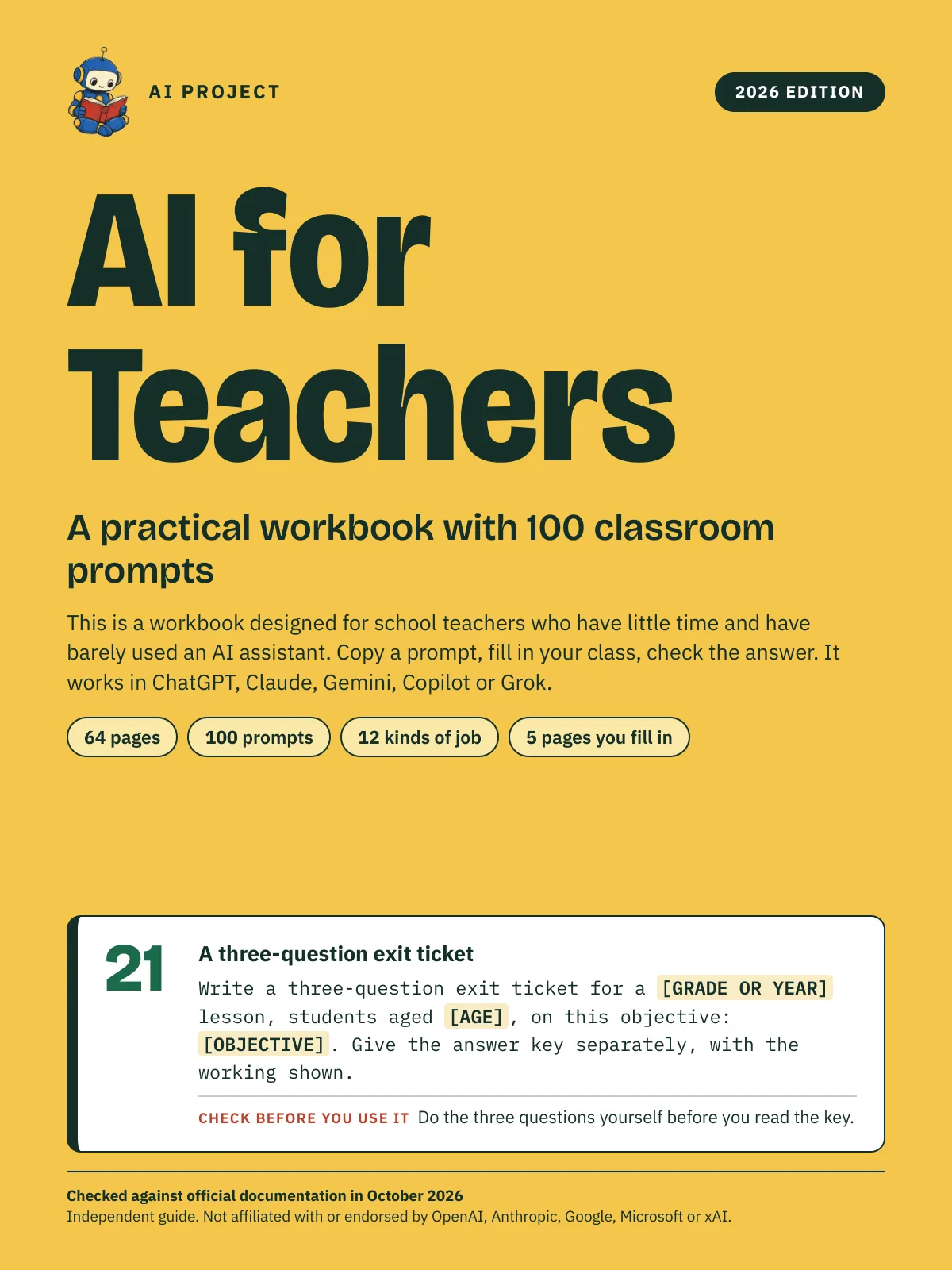 Item 1478
AI for Teachers: A Practical Workbook with 100 Classroom Prompts (2026 Edition)
AI Project
$12.99Was $19.99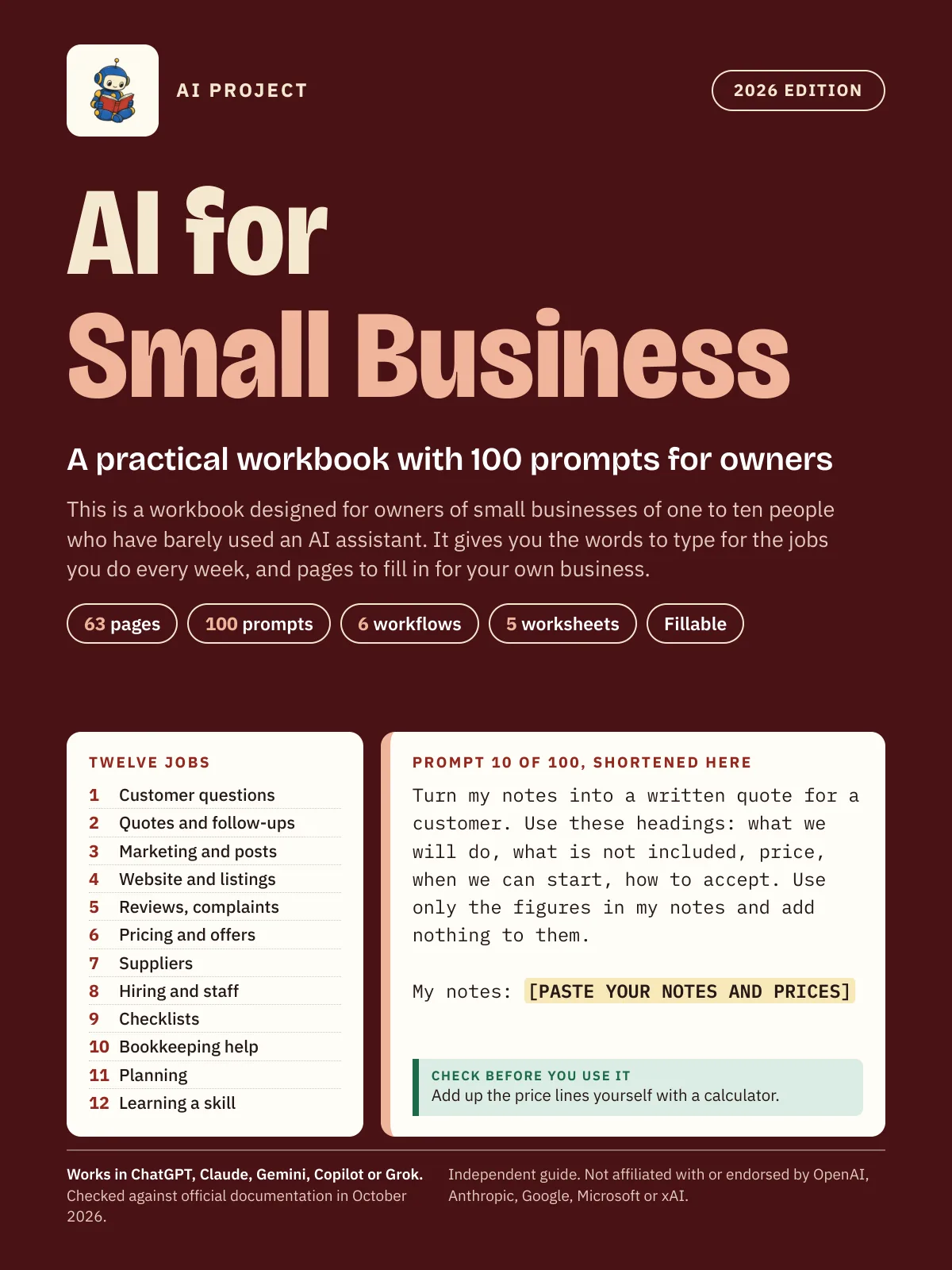 Item 1475
AI for Small Business: A Practical Workbook with 100 Prompts for Owners (2026 Edition)
AI Project
$12.99Was $19.99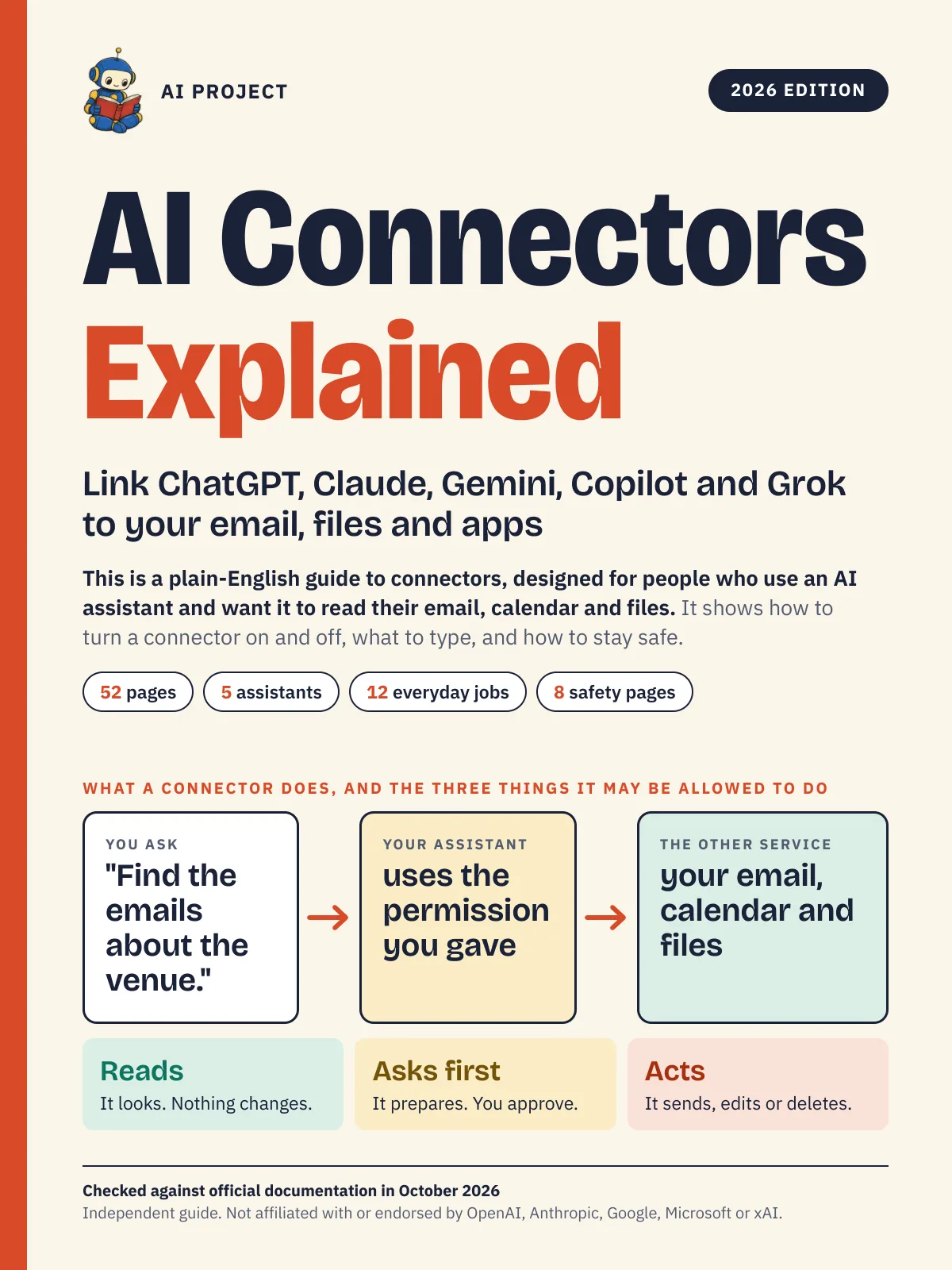 Item 1476
AI Connectors Explained: Link ChatGPT, Claude, Gemini, Copilot and Grok to Your Email, Files and Apps (2026 Edition)
AI Project
$12.99Was $19.99