
Look inside
Microsoft Copilot for Beginners: A Practical Guide for Work and Home (2026 Edition)
A step-by-step guide to the Microsoft Copilot AI assistant, designed for people who are new to it at work or at home
By AI Project
Price
$12.99Was $19.99
Buying opens soon. Nothing on Bookstorez is on sale yet.
Look inside
What you get
| File | Format | Size |
|---|---|---|
| copilot-for-beginners-screen-letter.pdf | 2.4 MB | |
| copilot-for-beginners-screen-a4.pdf | 2.4 MB | |
| copilot-for-beginners-my-prompts-fillable-letter.pdf | 87.7 KB | |
| copilot-for-beginners-my-prompts-fillable-a4.pdf | 88.3 KB | |
| copilot-for-beginners-print-edition-and-prompts.zip | ZIP | 3.8 MB |
| Pages | 60 pages | |
About this product
This is a step-by-step guide to the Microsoft Copilot AI assistant, designed for people who are new to it at work or at home, or who have it on their computer and have never been shown how to use it. 2026 edition: 60 pages, 15 features, 10 everyday jobs, 40 prompts.
Copilot is an AI assistant made by Microsoft. You type a message, called a prompt, and it writes back. It can explain, summarize, draft, plan, read your files and search the web, and it works inside Word, Excel, PowerPoint, Outlook and Teams. Most beginners type one short question, get a general answer and stop there. This guide shows you what to type instead, where each feature is, and how to check what comes back.
Checked against Microsoft's official documentation in October 2026. Every feature name, button and setting in the guide was read that month on Microsoft's own support pages: 90 official pages, listed on the last page. Microsoft merged its Copilot apps into one in August 2026 and renamed several things, so much older advice is out of date. Where Microsoft's own pages did not agree or did not say, the guide tells you so plainly and tells you to trust your screen.
Which Copilot do you have? Two people can open the same app and see different things. The reason is nearly always the account: a personal Microsoft account or a work or school account. One page near the front shows you how to tell, what each one can see, and which pages of the guide apply to you. Every feature page is tagged with who has it.
How you use it
- Find out which Copilot you have, and where things are on the screen.
- Follow the worked first conversation, typing the exact prompts shown.
- Learn six prompting habits. Each has a vague prompt, the improved prompt with its parts marked, and why it works.
- Pick one of ten everyday jobs and do it with your own material.
- Keep the prompt library and the quick reference open while you work.
What is inside (60 pages)
- Start here and a one-page map of the guide, with linked contents.
- Meet Copilot (5 pages): what it is in plain words, what it is good and not good at, which Copilot you have (personal account or work or school account), free and paid in general terms, and a simple drawing of the app with ten numbered parts.
- Your first conversation (2 pages): one worked example in six steps, with the exact prompts and what you might get back.
- Prompting well (8 pages): the four parts of a prompt in Microsoft's own guidance (Goal, Context, Source, Expectations), six habits that follow that guidance, each with a before and an after, and a page of follow-ups for when the first answer is not right.
- The features (18 pages): uploading files and images, web search and sources, conversation modes and the model picker, Copilot Voice and vision, creating images, Copilot Pages, memory and custom instructions, connectors, Copilot in Word, Copilot in Excel, Copilot in PowerPoint, Copilot in Outlook, Copilot in Teams, Work IQ and your work files, and Cowork. Each page says what the feature is for, how to find it and who has it, with a worked example. Then nine more things worth knowing, and a page on limits and AI credits.
- Ten everyday jobs (10 pages): answer a long email thread, turn rough notes into meeting minutes, write the first draft of a report, make sense of a spreadsheet, build a presentation from an outline, catch up after time away, prepare for a meeting, compare two quotes, rewrite a policy in plain English, and help a child study for a test. Each has the prompt, what to expect, two follow-ups and a final check.
- Checking and privacy (4 pages): the five ways Copilot goes wrong, five checks to run before you rely on an answer, privacy at home with a personal account, and privacy at work with a work or school account.
- A prompt library (5 pages): 40 copy-and-paste prompts in eight groups: email, meetings, documents, spreadsheets, presentations, planning, learning and home, and checking Copilot's answers.
- Reference: fillable "My prompts" pages with a filled-in example first, a glossary of 30 terms, a quick reference and the list of sources.
What it does not do
- It does not quote subscription prices, AI credit amounts or usage allowances. They change, and it points you to Microsoft's own pages.
- It does not cover GitHub Copilot, Copilot Studio, building your own agents or the settings for IT administrators.
- It uses simple drawings of the screen, not screenshots.
- It does not promise results, income or time saved.
What you download
- The guide in US Letter and A4, for reading on screen, with linked contents and page references.
- Fillable "My prompts" pages in both sizes, for typing into on a computer.
- One ZIP with the low-ink print edition in both sizes (white pages, light on ink), every prompt in one plain-text file, and the Start here page.
- The plain-text file opens on any computer, tablet or phone and is the easiest place to copy a prompt from.
- You need only one paper size: Letter for the USA and Canada, A4 for almost everywhere else.
Good to know
- Independent guide. Not affiliated with or endorsed by Microsoft.
- You need access to Copilot, which is not included. The free version is enough for the first half of the guide. Pages that need a Microsoft 365 subscription or a work license say so, and the five pages on Word, Excel, PowerPoint, Outlook and Teams need one. Microsoft sets a minimum age of 13, higher in some countries.
- 2026 edition, checked October 2026. Copilot changes often, and what you see also depends on your account, your region and, at work, on what your organization has switched on.
- Copilot can be wrong and sound sure. The guide gives you the checks; what you do with an answer stays your responsibility. It is not legal, financial, medical or IT compliance advice.
- The fillable pages are made for a desktop PDF reader such as the free Adobe Acrobat Reader. Many phone and tablet apps do not keep typed entries.
- Print at 100% or "actual size", not "fit to page".
Contents
- Cover
- Start here
- Start here
- Map of this guide, and contents
- Meet Copilot
- What Copilot is, and where you use it
- What Copilot is good at, and not good at
- Which Copilot do you have?
- Free and paid, in general terms
- Finding your way around the app
- Your first conversation
- A first conversation, step by step
- Prompting well
- How a good prompt is built
- Habit 1: Start with a clear goal
- Habit 2: Add context: why, and for whom
- Habit 3: Name your source
- Habit 4: Set expectations for the answer
- Habit 5: Put things in order, and keep documents short
- Habit 6: Treat the first answer as a draft
- The second message: follow-ups that work
- The features
- The features at a glance
- Upload files and images
- Web search and sources
- Modes and the model picker
- Voice and vision
- Create images
- Copilot Pages
- Memory and instructions
- Connectors
- Copilot in Word
- Copilot in Excel
- Copilot in PowerPoint
- Copilot in Outlook
- Copilot in Teams
- Work IQ and your work files
- Cowork
- Also worth knowing
- Limits, AI credits and busy times
More from AI Project
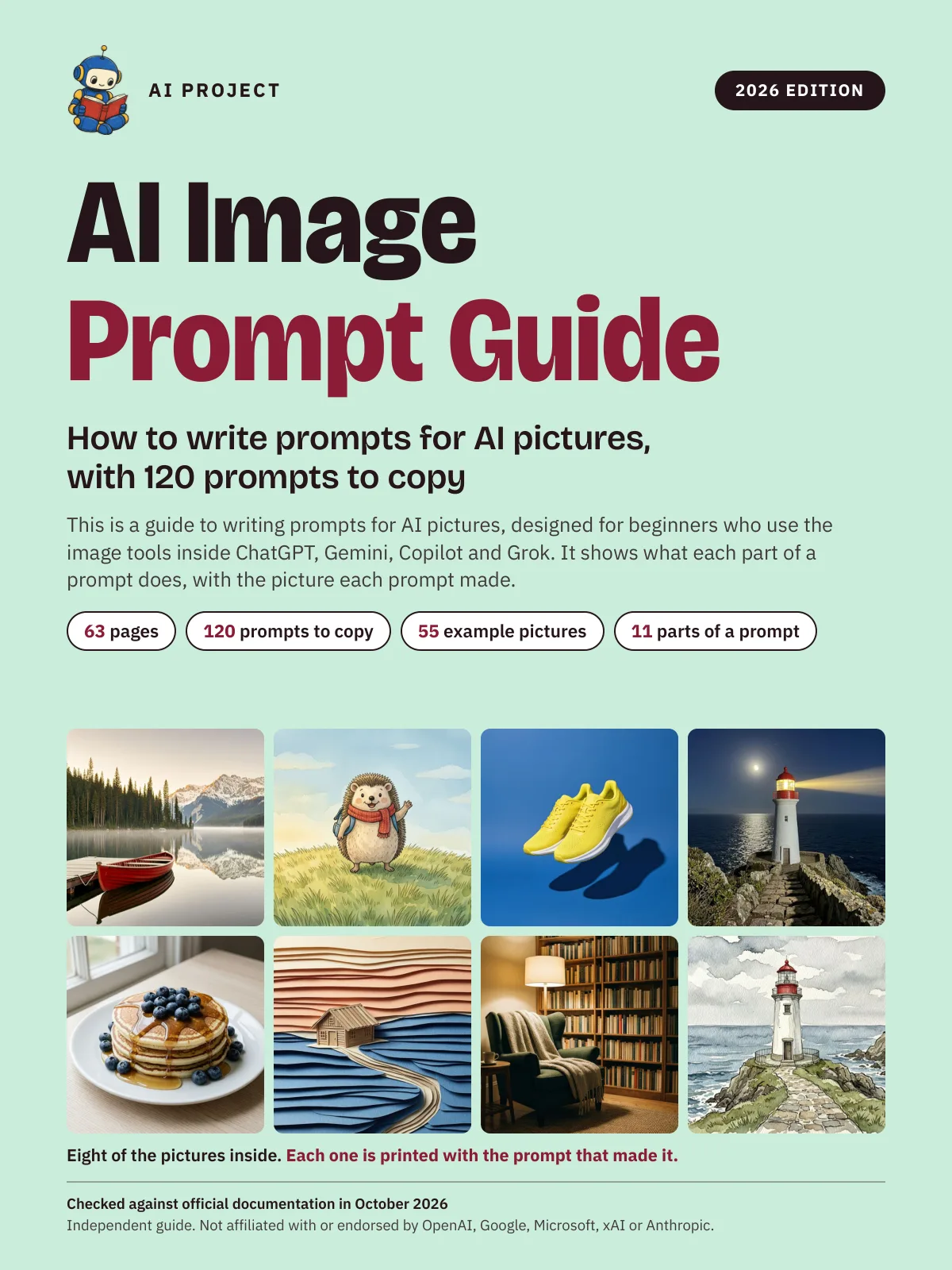 Item 1479
AI Image Prompt Guide: How to Write Prompts for AI Pictures, with 120 Prompts to Copy (2026 Edition)
AI Project
$9.99Was $15.99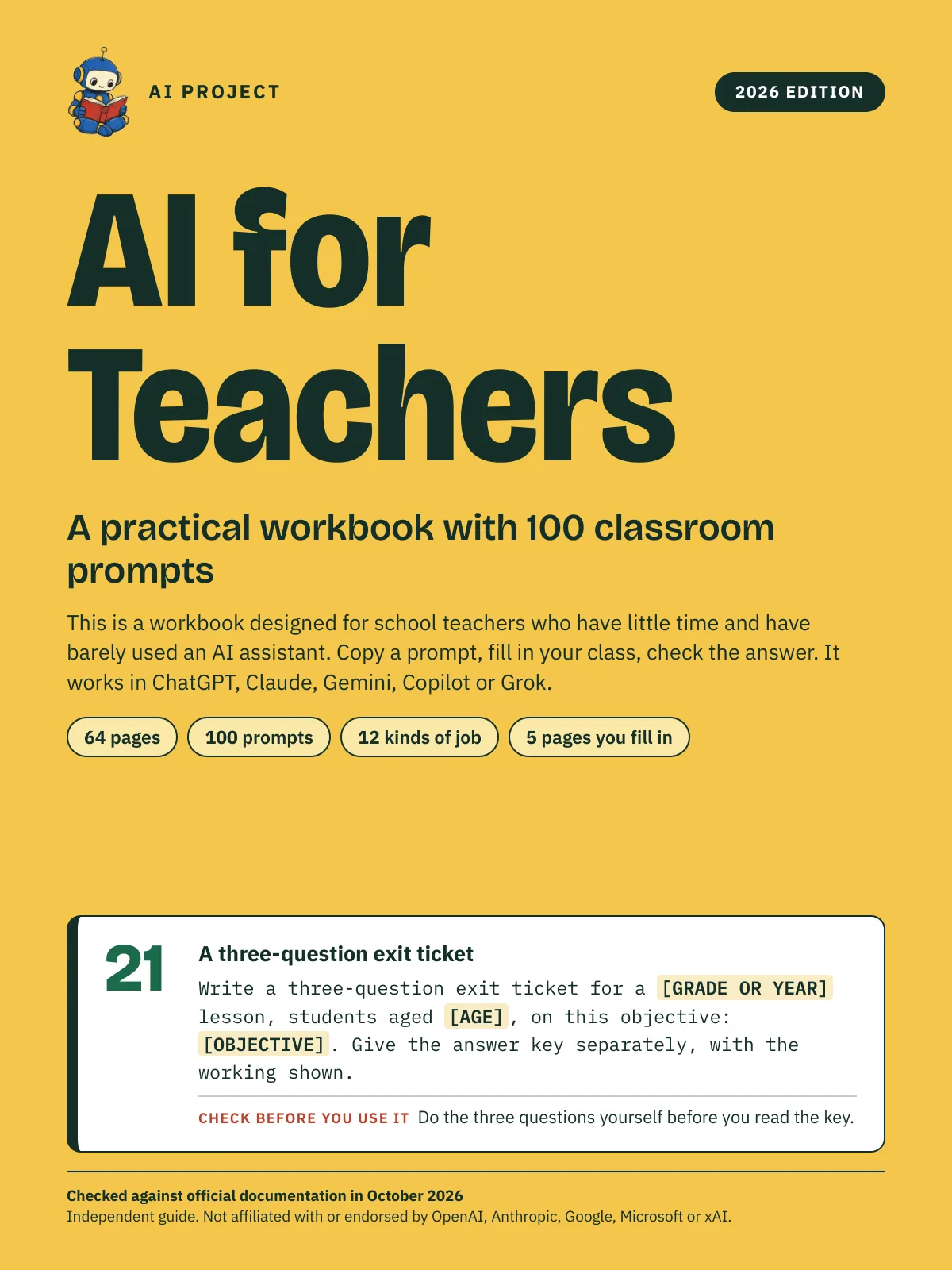 Item 1478
AI for Teachers: A Practical Workbook with 100 Classroom Prompts (2026 Edition)
AI Project
$12.99Was $19.99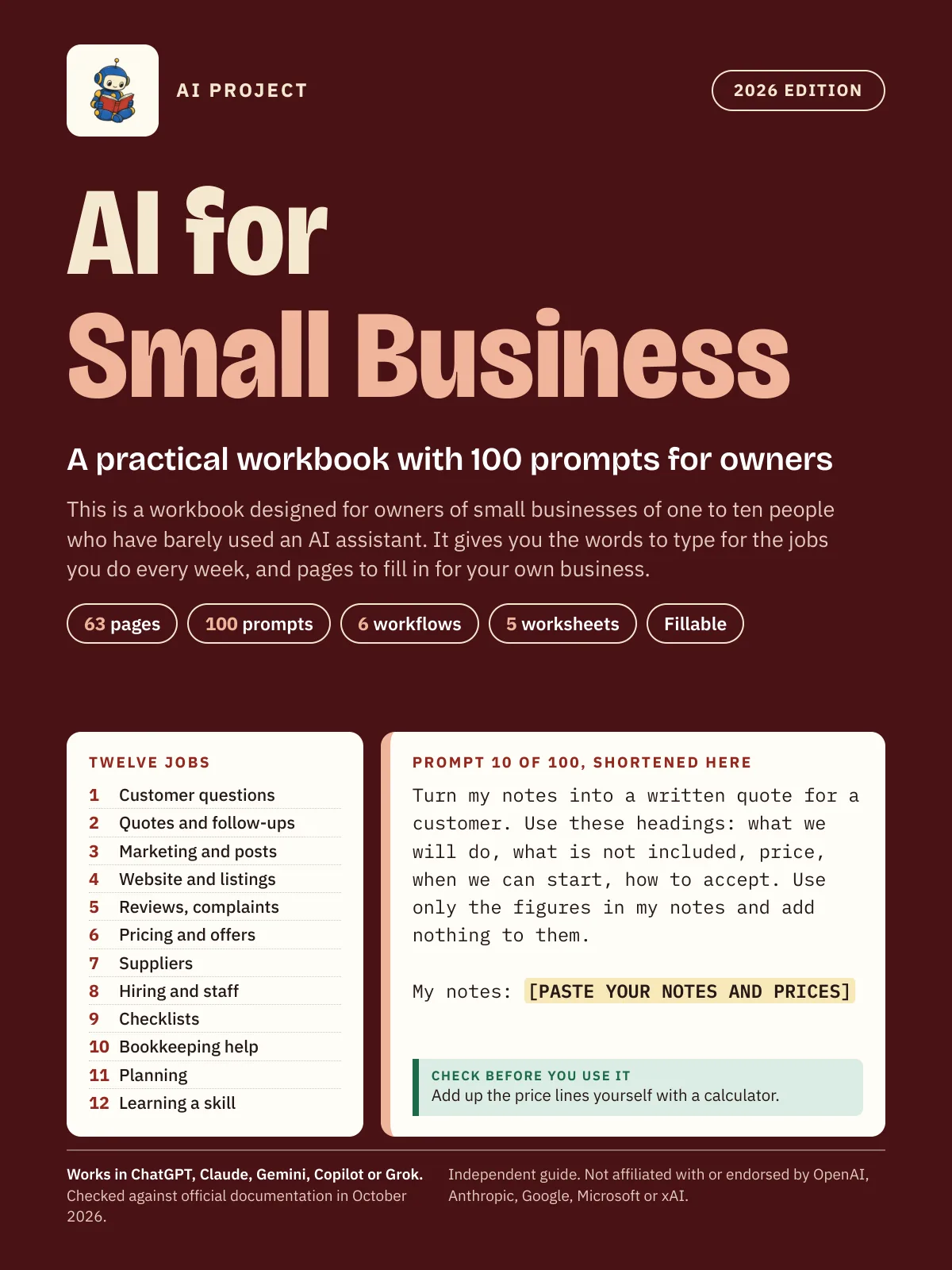 Item 1475
AI for Small Business: A Practical Workbook with 100 Prompts for Owners (2026 Edition)
AI Project
$12.99Was $19.99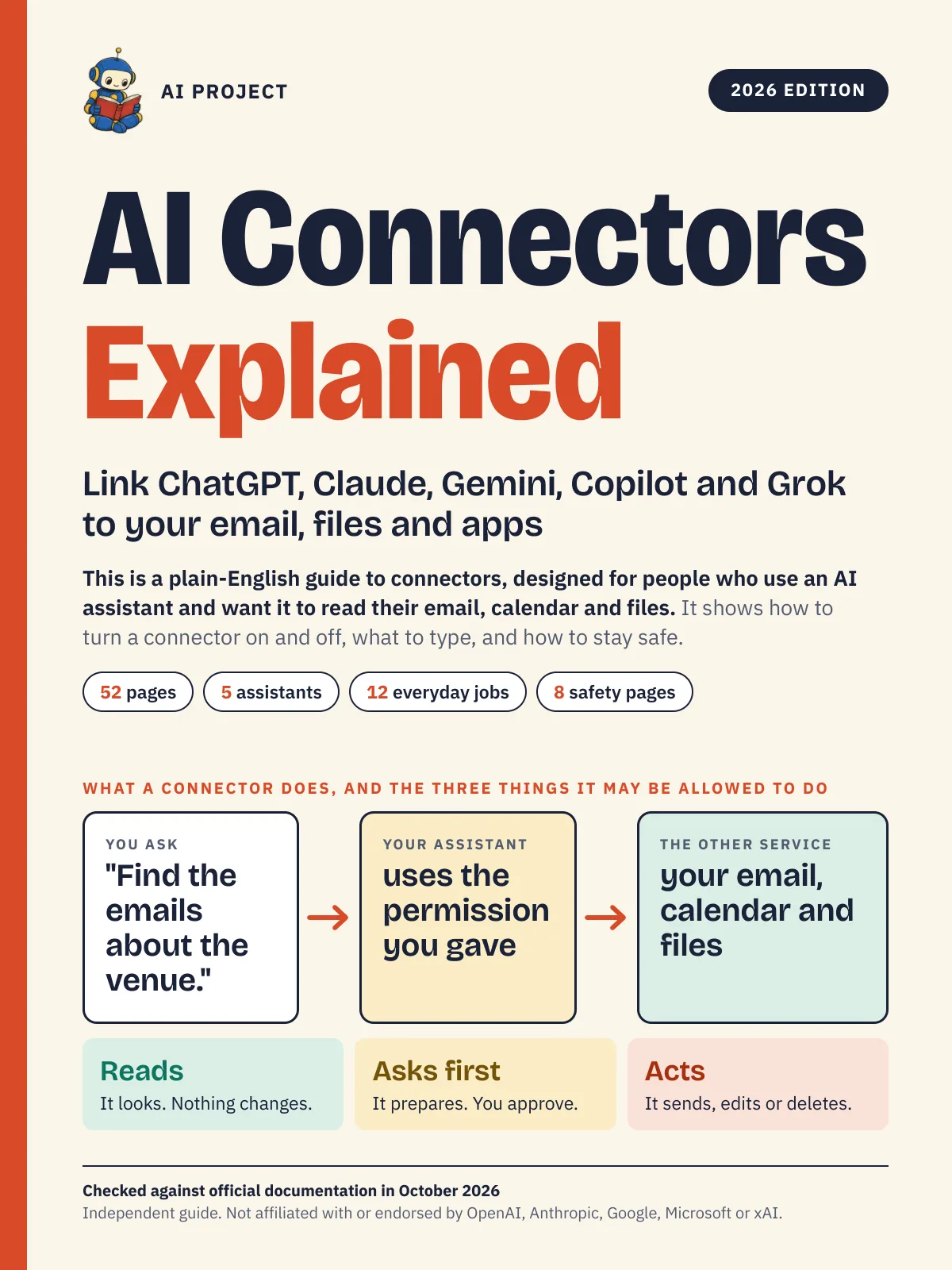 Item 1476
AI Connectors Explained: Link ChatGPT, Claude, Gemini, Copilot and Grok to Your Email, Files and Apps (2026 Edition)
AI Project
$12.99Was $19.99